Plant-Floor Ethernet Is Different
Office ethernet runs through climate-controlled ceilings to docked laptops. Plant-floor ethernet runs through cable tray next to a 200hp VFD output, terminates on a robot arm that moves 10,000 cycles per shift, gets washed down at end of shift, and has to deliver sub-millisecond determinism to a PLC controlling a press that could kill someone if the network drops a packet at the wrong moment.
Industrial ethernet cable is engineered for that environment: heavier shielding, tougher jacket, wider temperature range, higher flex life, and stricter electrical specifications. This guide covers what to specify, where to use it, and how to terminate so the network actually delivers what the protocol promises.
Cable Construction for Industrial Use
Industrial cable starts with a Cat5e or Cat6 electrical specification and adds layers of physical protection.
| Layer | Office Cable | Industrial Cable | Why It Matters |
|---|---|---|---|
| Conductor | Solid copper, 23-24 AWG | Stranded copper for flex; solid for fixed runs | Stranded survives flexing; solid handles longer runs |
| Pair shielding | None (UTP) | Foil per pair (FTP) common | Reduces alien crosstalk and EMI ingress |
| Overall shield | None (UTP) | Braid, foil, or both (S/FTP, F/FTP) | Critical for VFD-rich environments |
| Jacket material | PVC or LSZH | TPE, PUR, or silicone | Oil/chemical/UV resistance, flex life |
| Temperature rating | 0°C to +60°C typical | -40°C to +80°C (or higher) | Plant floor extremes, outdoor exposure |
| Flex rating | Static install only | Up to 5+ million cycles for drag chain | Required on robot arms, gantries, c-tracks |
| Jacket color | Blue/white/gray | Green (PROFINET), purple (EtherNet/IP), yellow (EtherCAT) | Protocol identification at a glance |
Protocol-Specific Requirements
PROFINET
PROFINET defines three cable types: Type A (fixed install), Type B (flexible install with occasional movement), and Type C (highly flexible for drag chain). All are Cat5e-based, shielded, and green-jacketed. PROFINET RT (real-time) tolerates standard managed switches; PROFINET IRT (isochronous real-time) requires PROFINET-certified switches with hardware time synchronization.
EtherNet/IP
EtherNet/IP is the ODVA's specification, common in Allen-Bradley/Rockwell environments. It uses standard Cat5e or Cat6 ethernet, typically with shielded cable in industrial environments. Color convention is purple or gray. EtherNet/IP supports CIP Sync (PTP) for time-synchronized motion control, which requires switches with PTP hardware support.
EtherCAT
EtherCAT runs on standard Cat5e cable but uses a unique pass-through topology where each device modifies the frame as it transits. Cable can be standard industrial Cat5e shielded; what matters more is the device topology and master/slave configuration. EtherCAT cable often uses a yellow jacket convention.
Modbus TCP
The most permissive of the industrial protocols — runs on standard ethernet cable. Use industrial-grade shielded Cat5e or Cat6 to handle the plant environment, but no special protocol-specific cable required.
EMI Mitigation
Variable Frequency Drives are the single biggest source of EMI in a modern plant. VFD output cables carry switched DC at frequencies that can radiate hundreds of meters. Industrial ethernet cable has to coexist with that environment — the cable can do its job, but only if pathway and bonding are right.
Separation Distances
- From low-voltage AC power (under 480V): 6 inches minimum parallel separation, or use grounded metal divider in shared tray
- From medium-voltage power (480V-5kV): 12 inches minimum parallel separation
- From VFD output cables: 12 inches minimum, ideally use separate metallic conduit
- From welding cables: Avoid parallel runs entirely; cross at 90 degrees if unavoidable
- Crossing power runs: 90-degree crossing requires no separation distance
Shield Grounding
Bond the cable shield to chassis ground at the cabinet entry — typically at a shielded RJ45 patch panel or at the metallic backshell of an M12 bulkhead. Do not bond at both ends; the resulting ground loop will inject 60Hz noise into the data path. The exception is properly designed industrial cable systems with single-point grounding through the cable carrier — these are engineered as a system.
Connector Strategy: M12 vs RJ45
RJ45 (Inside Sealed Cabinets Only)
RJ45 is acceptable for switch ports inside a properly sealed (NEMA 12 or higher) control cabinet. The connector itself is not rated for plant floor exposure — vibration loosens the locking tab, oil and water track into the contacts, and frequent disconnection wears the gold plating off the pins. Inside a sealed cabinet, RJ45 works fine and matches what most managed industrial switches offer.
M12 D-coded (100Mbps)
Four-pin M12 connector with D-coding for industrial 100Mbps ethernet. IP67 rated when properly torqued. Used at every device-side connection on the plant floor. Standard for sensors, drives, RFID readers, and 100Mbps PLCs.
M12 X-coded (1Gbps and faster)
Eight-pin M12 connector with X-coding for industrial gigabit ethernet. Backward compatible signaling with M12 D-coded but higher pin count. Used for high-bandwidth devices like vision systems, robot controllers, and gigabit-capable PLCs.
Standard Architecture
Switch (RJ45) → patch cord → patch panel (RJ45) → field cable → bulkhead M12 at cabinet exit → M12 patch cord → device. The transition point is the cabinet wall, where the bulkhead provides both the protocol conversion (RJ45 to M12) and the IP-rated weatherproof seal.
Termination Tools and Practices
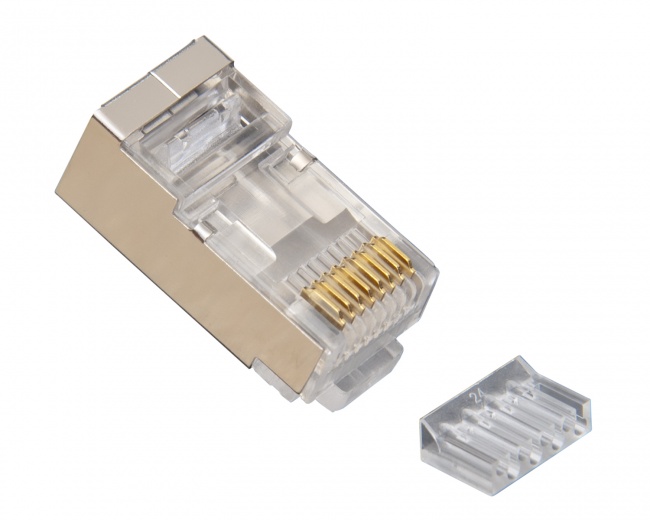
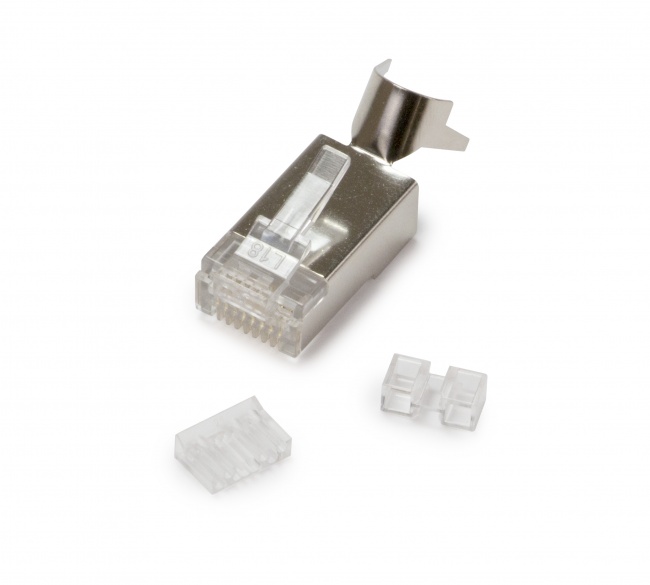
Industrial ethernet termination requires the same precision as office ethernet plus the cable handling for stranded conductors and shielded constructions. The same EZ-RJ45 feed-through approach works for shielded industrial cable when paired with the appropriate shielded connector and crimp die.
Stranded Cable Termination
Industrial drag-chain cable uses stranded conductors. Standard RJ45 connectors with IDC contacts designed for solid conductors will not make reliable contact with stranded — the IDC tine slides between the strands rather than displacing insulation. Use connectors specifically rated for stranded conductors, or terminate stranded cable on a punch-down patch panel and use a short solid patch cord between panel and switch.
Shielded Termination
Strip cable jacket to expose foil/braid shield. Fold shield back over jacket, then slide shielded connector body over folded shield to make 360-degree contact. Crimp the shield termination separately from the conductor crimp. Verify continuity from cable shield to connector backshell with a multimeter before installing.
Pathway and Mounting
Cable Tray
Use dedicated low-voltage cable tray separated from power tray by at least 6 inches (low voltage AC) to 12 inches (medium voltage). Steel ladder tray with grounding straps is the industrial standard. Maintain bend radius of 4× cable OD minimum on all transitions.
Conduit
Liquid-tight flexible metallic conduit (LFMC) is the standard for connections from cabinet to device. Provides physical protection and EMI shielding. Use RMC (rigid metallic conduit) for long fixed runs. Always ground conduit per NEC.
Drag Chain (Cable Carrier)
Use cable specifically rated for drag chain — typical office or even industrial fixed-install cable will fail in months under cycling. PROFINET Type C, or generic industrial drag-chain cable, has a flex rating measured in millions of cycles. Specify the bend radius required by the cable carrier and verify the cable's minimum bend radius is smaller. Bundle with cable management designed for drag chain — never zip-ties (they wear through the jacket).
Switch Selection for Industrial Networks
Industrial ethernet switches differ from office switches in several important ways:
- DIN-rail mountable: Standard form factor for control cabinet installation
- Wide-range DC power: Typically 24VDC or dual 24VDC inputs for redundancy
- Extended temperature rating: -40°C to +75°C operating range
- No fans: Convection-cooled for reliability in dusty environments
- Conformal coating: Circuit boards coated against humidity and corrosive atmospheres
- Protocol features: PROFINET conformance, PTP support, MRP (Media Redundancy Protocol) ring topology
- Field replaceable: Removable storage card so configuration moves to a replacement switch in minutes
Documentation and Certification
Industrial networks need documentation just like commercial installs — and arguably more so, because the maintenance crew called at 2am to a downed line needs to find the cable fault fast.
- Cable schedule with from/to, length, cable type, and tray section for every drop
- Network topology diagram showing rings, redundant paths, and master/slave relationships
- Switch port assignments and VLAN structure
- Certification report per drop (wiremap, length, propagation delay)
- Spare parts inventory: 5% spare cable on the spool, 10 spare M12 connectors, 1 spare switch per stack
- Photo set of cabinet build with cable bundles and labels
Recommended Products
The following CrimpShop products are commonly stocked for industrial ethernet termination work:
Related Articles
- Warehouse Wireless vs Wired Cabling — Companion piece for warehouse and DC environments.
- Cat6 vs Cat6A: What's the Difference? — Cable category selection for industrial use.
- PoE Cable Requirements — PoE cable, gauge, and heat considerations for long PoE runs.
Frequently Asked Questions
What is industrial ethernet cable?
Industrial ethernet cable is ruggedized network cable designed for plant-floor and outdoor industrial environments. It uses heavier shielding (typically S/FTP or F/FTP), oil- and chemical-resistant TPE or PUR jackets, increased temperature ratings (-40°C to +80°C or higher), high flex ratings for cable carrier (drag chain) use, and EMI immunity sufficient to operate alongside VFDs, motors, and high-current bus bars. Common protocols include PROFINET, EtherNet/IP, EtherCAT, and Modbus TCP.
What is the difference between PROFINET and EtherNet/IP cable?
Both protocols use standard ethernet physical layer cabling, but each has its own conformance specification and color convention: PROFINET cable is green-jacketed and certified to PROFINET Type A/B/C specifications (Type C is highly flexible for drag chain); EtherNet/IP traditionally uses purple or gray jacket and follows ODVA recommendations. The underlying construction is similar — Cat5e or Cat6 with appropriate shielding — but using protocol-branded cable simplifies certification and troubleshooting in an audited plant.
When should I use M12 connectors instead of RJ45?
Use M12 (D-coded for 100Mbps, X-coded for 1Gbps) on the device side anywhere the connection sees vibration, washdown, oil contamination, or frequent disconnection. RJ45 is acceptable inside sealed control cabinets but fails quickly in open plant environments. The standard architecture is RJ45 from the switch (in-cabinet), then M12 bulkhead at the cabinet exit, then M12-to-M12 patch cord to the device.
How do I prevent EMI from VFDs and motors?
Use double-shielded S/FTP cable with both braid and foil. Maintain 12-inch separation from VFD output cables and 6-inch separation from low-voltage power. Cross power runs at 90 degrees. Bond cable shields to ground at the cabinet entry only — never at both ends, which creates ground loops. Route ethernet in dedicated cable tray separated from power. For VFD output cables, use shielded VFD-rated cable and ground both ends of that shield.
What temperature rating do I need for plant floor cable?
Standard industrial ethernet cable is rated -40°C to +80°C, which covers most North American plant floor environments. Above-furnace, near-oven, or proximity to forging or casting equipment may require -40°C to +105°C silicone-jacketed cable. Below-zero outdoor industrial applications (mining, oil and gas) commonly use -55°C rated cable. Always check the actual ambient temperature at cable height — ceiling temperatures in a steel mill can exceed cable jacket ratings even when floor temperature feels normal.
Stock Industrial Termination Tools
CrimpShop carries the EZ-RJ45 connectors, crimp tools, and cable testers that industrial integrators rely on for plant-floor ethernet that runs reliably alongside VFDs and motors.
Shop Industrial Cabling Tools