The Quick Answer
Most cable runs in finished construction follow the same pattern. You enter the wall from above (attic) or below (basement or crawlspace), travel vertically inside the stud bay, and exit at a wall plate cut into the drywall. The trick is choosing the right wall, anticipating the obstructions, and using the right tools to get through them without making more holes than you patch.
Plan the Path Before You Drill
Start with the device end
Pick the exact spot for the wall plate first. Mid-stud-bay is required; you cannot mount a low-voltage bracket directly into a stud. Use a stud finder to verify the location is empty, then mark the cutout for the bracket.
Pick the entry point
Look up. If there is attic above, that is your top entry. The wall's top plate is typically a 1.5-inch-thick 2x4 you drill through from above. If there is a finished ceiling above (no attic, just another floor), the path becomes much harder; you may need to go through a closet, a soffit, or run on the exterior.
Look down. A basement or crawl space below is the other easy entry. Drill up through the bottom plate from the basement.
If you cannot go up or down easily, you need a horizontal run inside an interior wall, which means dealing with fire blocks and possibly insulation. This takes longer.
Identify obstructions
- Fire blocks: Horizontal 2x4 lumber every 8-10 feet in tall walls. Common above doors, windows, and at floor-to-ceiling boundaries.
- Insulation: Exterior walls have insulation that fish tape cannot easily penetrate. Interior walls are usually empty unless they are sound-rated walls between bedrooms or bathrooms.
- Electrical home runs: Romex cables travel through stud bays, often horizontally between outlets. Hitting one with a drill is a fire risk.
- HVAC ducts: Less common in stud bays but possible, especially in retrofit installations.
- Plumbing: Especially around bathrooms and kitchens. Drain stacks, supply lines, and vents all run vertically through walls.
Tools for Fishing Cable
Essential
| Tool | Use |
|---|---|
| Stud finder with AC detection | Locate studs, electrical wires, and metal in walls |
| Drywall saw or oscillating tool | Cut wall plate openings and inspection holes |
| Long flexible drill bit (18-24 inches) | Drill through plates, fire blocks, and from awkward angles |
| Fish tape (50-foot fiberglass) | Long horizontal and vertical pulls |
| Glow rod kit (5 to 6 sticks) | Short pushes through insulation, finding holes from the other side |
| Strong magnet pull kit | Locate cable in wall cavity and steer it to a hole |
| Low-voltage mounting brackets | Wall plate mount without a full electrical box |
Useful additions
- Right-angle drill: Drill through fire blocks from inside the wall cavity without cutting the wall apart.
- Inspection camera: Look inside the wall cavity through a small hole before committing to a path.
- Cable lubricant: Reduces friction on long pulls; stays in place on twisted pair.
- Pulling string: Pull a string through first, then use the string to pull the actual cable.
For organizing cable in attics and chases between fishing operations, Standard J-Hooks and HPH J-Hooks keep cable runs supported per code. Cable Xtender Poles extend your reach when running cable across long attic spans.
Top-Down Method (Through the Attic)
If your home or office has accessible attic space above the work area, this is the easiest path.
Step 1: Cut the wall plate opening
From inside the room, locate the spot for the wall plate. Verify with a stud finder that the location is in an empty stud bay with no electrical or plumbing immediately above. Cut a low-voltage mounting bracket opening with a drywall saw.
Step 2: Find the stud bay from the attic
From the attic, locate the wall directly above the cutout. The top plate of the wall runs along the top of the wall. Find the section of top plate that corresponds to your stud bay. A useful trick: drill a small finder hole down through the wall plate while a partner inside the room watches for the bit to come through. The drill bit's exit point tells you exactly which stud bay you are in.
Step 3: Drill through the top plate
Drill a 3/4-inch hole through the top plate, in the middle of the stud bay you targeted. Use a long flexible bit so you can drill straight down without contorting yourself. Avoid drilling near the edges of the top plate to maintain structural strength.
Step 4: Drop the fish tape
Push a fish tape down through the hole. The tape will travel down the inside of the stud bay until it reaches the floor, a fire block, or your wall plate cutout (if it is below the fire block).
Step 5: Catch the tape at the cutout
Inside the room, reach into the wall plate cutout and find the end of the fish tape. Pull a few feet out through the cutout. Attach your cable to the end of the tape with electrical tape, making a smooth taper so the splice does not snag on the cavity edges.
Step 6: Pull the cable up to the attic
From the attic, pull the fish tape back up. The cable follows. Pull until you have enough slack at both ends to terminate.
Step 7: Route across the attic
From the top of the wall, route the cable across the attic to your service location (rack, switch, or termination point). Use J-hooks every 4-5 feet to keep the cable off the insulation and supported per code. Avoid laying cable directly on the ceiling drywall; the heat in the attic and the weight of insulation can cause long-term damage.
Bottom-Up Method (Through the Basement)
If the work area is on the first floor and the basement is unfinished or partially finished, the bottom-up method works the same way as top-down but in reverse.
Locate the bottom plate from below
From the basement, find the section of the floor joist system that lines up with the wall above. The wall's bottom plate sits on the subfloor. Drill up through the subfloor and then up through the bottom plate to enter the stud bay.
Reverse the steps
Push fish tape up from the basement. Catch it at the wall plate cutout above. Attach cable. Pull tape and cable down into the basement. Route the cable in the basement to its destination.
Watch for plumbing and electrical
The basement ceiling is full of plumbing supply lines, drain stacks, and electrical home runs. Drilling up blindly is risky. Use a stud finder from above (in the room being wired) to confirm the area is clear before drilling from below. If the basement is finished with a drop ceiling, lift a tile to see the joist bay before drilling.
Fishing Through Fire Blocks
Fire blocks stop a fish tape cold. You have two ways to get through them.
Cut an inspection hole
Cut a small (4x4 inch) inspection hole at the height of the fire block. Reach in with a long drill bit and drill through the fire block. Patch the inspection hole with a piece of drywall and joint compound, then paint to match.
This is the most common method. The patch is small enough to disappear after texture and paint, and the access lets you see exactly what you are drilling into.
Use a right-angle drill from inside the cavity
If you have a small right-angle drill or a drilling adapter that fits in the wall cavity, you can drill through a fire block from above or below using only a single 2x2 inch access hole. This minimizes patching but requires specialized tools.
Pulling Without Damaging Cable
Cat6 and Cat6A cable have specific pull tension limits. Exceeding them stretches the conductors and degrades performance.
- Cat5e and Cat6: Maximum 25 lbs of pull tension
- Cat6A: Maximum 25 lbs (per TIA-568) but generally treat the same
- Bend radius: No tighter than 4 times the cable diameter (about 1 inch for Cat6, 1.25 inches for Cat6A)
Twenty-five pounds of pull is more than you might think; for reference, a typical fishing rod feels like 10-15 pounds at heavy load. The number matters when pulling long horizontal runs or when the cable snags on something. If pulling becomes hard, stop, find the snag, and free it. Do not just pull harder.
Use a pulling lubricant for hard runs
Cable lubricant designed for low-voltage cable reduces friction without damaging the jacket. Apply at the entry point of a long pull. Avoid silicone-based lubricants that can migrate down the cable and contaminate connectors.
Common Problems and Fixes
The fish tape stops short
Probably hit a fire block, an electrical wire, or insulation. Pull back and try again with the tape angled slightly differently. If it stops at the same place every time, you have a fire block; cut an inspection hole.
The fish tape went down but cannot be found
The tape may have gone into the wrong stud bay (drift). Use a magnetic fish kit: attach a powerful magnet to a string and lower it into the wall cavity from above. From inside the room, hold a smaller magnet against the drywall and "feel" for the magnet inside the cavity. You can locate and steer cable using just two magnets.
The cable kinked during pulling
If you feel a kink form during a pull, stop, back off, and free the snag. A kinked Cat6A cable has permanently damaged pair geometry and will fail certification at high speeds. If the kink happened, replace the entire run.
Insulation in the way
Exterior walls have batts of fiberglass or blown cellulose insulation. Fish tape goes nowhere through it. Glow rods can sometimes push through batts; cellulose is harder. For exterior walls, sometimes the only path is to cut a series of inspection holes and pull the cable in segments.
Finishing the Run
Mount the bracket
After fishing the cable through, install a low-voltage mounting bracket in the wall opening. The bracket has tabs that grip the back of the drywall to hold it in place without a full electrical box. Pull the cable through the bracket opening.
Terminate the cable
Terminate the cable to a keystone jack and snap the jack into the wall plate. For technique, see our keystone jack installation guide. For a deeper look at running long horizontal runs, see how to pull Ethernet cable for long runs.
Test the run
Test wire map and length with a VDV MapMaster 3.0. On a Cat6A job the throughput question is a certifier question, and renting one for the week is the normal route when a contract asks for it.
Patch the inspection holes
Patch any inspection holes you cut along the path with drywall, joint compound, and texture matching. Allow drying time, sand smooth, and paint to match. A clean patch disappears entirely after a primer coat.
Recommended Products
Cable Management
Support cable runs in attics, chases, and ceilings
Standard J-hooks for ceiling runs. The Xtender Pole gives reach for installing hooks in tall attic spaces.
Termination
Connectors and tools for finishing the run
Pass-through Cat6A connectors for plug terminations. Punchdown kit for keystone jacks at the wall plate.
Testing and Tracing
Verify the finished run and trace the cable path
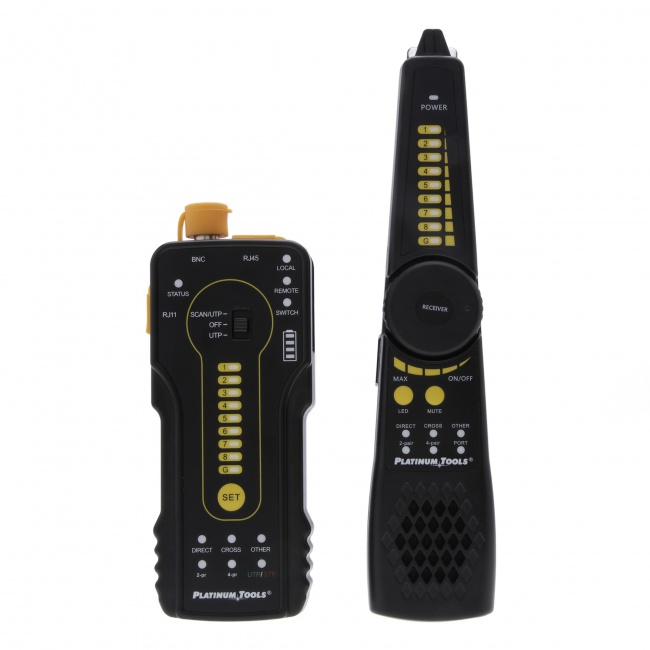
Tone and probe locates the cable inside the wall during the pull. The MapMaster confirms the finished run is wired right and measures its length.
Related Articles
Frequently Asked Questions
What is the easiest way to fish cable through a wall?
The easiest path is straight down from the attic to a single-story room. Drill through the top plate from above, drop a fish tape or weighted line down, and pull the cable through. Vertical runs between floors require either an exterior or chase path, fishing through a soffit, or running along an existing duct or chase. Horizontal runs in finished walls are the hardest because of fire blocks and insulation.
Do I need a fish tape or a glow rod?
Both have their uses. Fish tape is flexible steel or fiberglass that can navigate around bends and obstacles in long horizontal runs. Glow rods are rigid fiberglass sticks that connect together and are best for poking through short distances, locating drilled holes from the other side, and pushing cable through insulation. Most installers carry both.
How do I avoid hitting electrical wiring inside a wall?
Use a stud finder with AC detection to identify hot wires before drilling. Drill slowly with a low-RPM drill so you can stop at the first sign of resistance. Stay at least 6 inches above or below outlets where possible, since electrical home runs typically travel horizontally at outlet height. When in doubt, cut a small inspection hole and look before drilling further.
What tools do I need to fish cable through walls?
At minimum: a stud finder, a long flexible drill bit (typically 18-24 inches), a fish tape or glow rod kit, a flashlight, and a low-voltage mounting bracket for the wall plate. For long runs, a magnetic fish kit helps when the cable is in a wall cavity but you cannot see exactly where it is. A Digital Tone and Probe Kit helps locate cable already in the wall.
How do I get through a fire block?
Fire blocks are horizontal 2x4s installed perpendicular to the studs at intervals to slow fire spread. To get through one, you usually have to cut an inspection hole at the level of the fire block, drill through it with a flexible drill bit, and patch the inspection hole afterward. Some installers use right-angle drills to drill through fire blocks from inside the wall cavity using only a small access hole.
Equip the Whole Cable Run
From the J-hooks in the attic to the keystone jack in the wall, stock the gear that makes a clean fish job. Then verify the finished run before you patch the drywall.