The Quick Answer
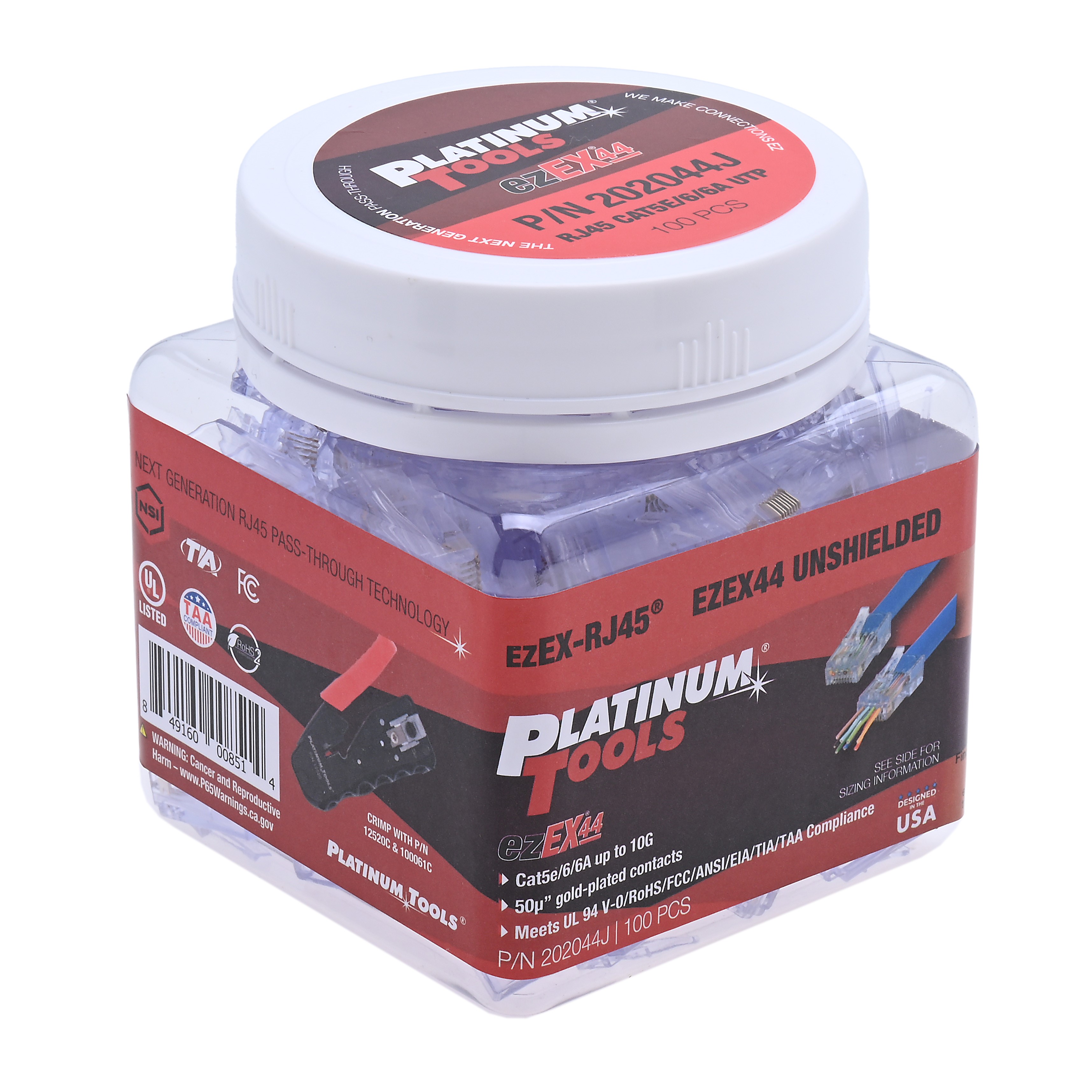
The ezEX family is Platinum Tools' answer to the problem that killed many EZ-RJ45 installations: cable conductors that are too thick for the connector wire channels. Cat6A cable, certain shielded cables, and some manufacturers' Cat6 use insulation that is fatter than the EZ-RJ45 was designed for. The ezEX line solved this by widening the wire channels and offering two different sizes for different cable diameters.
If you have searched for "ezEX44 vs ezEX48" you are likely about to buy a bag of connectors and want to make sure you order the right one. The decision comes down to three things: the cable category, the conductor insulation diameter, and how many cable types you regularly terminate.
What the 44 and 48 Actually Mean
Platinum Tools' naming convention encodes a real measurement into the product name. The two-digit number after "ezEX" is the maximum insulated conductor outer diameter the wire channels accept, expressed in tenths of a millimeter.
- ezEX44 = wire channels accept insulated conductors up to 4.4 dimensions meaning 1.10 mm outer diameter (the spec is 0.039 inches per channel divided across 8 channels in a wider housing).
- ezEX48 = wire channels accept insulated conductors up to 4.8 dimensions meaning 1.20 mm outer diameter, the largest of the ezEX series.
This is the bare copper conductor plus the colored insulation around it. Standard 23 AWG bare copper is approximately 0.57mm. The insulation thickness varies by manufacturer and cable construction, which is what determines whether your cable falls into the 44 range or the 48 range.
The connector body itself is dimensionally identical to a standard RJ45 plug. Both ezEX44 and ezEX48 fit any 8P8C jack, switch port, or patch panel. The only difference between the two is the internal wire channel diameter.
Why Conductor Diameter Matters
Pass-through connectors work by letting the conductors slide all the way through the connector front, where the crimp tool then trims them flush with the contact face. This requires the wires to physically pass through the wire channels without binding.
If your cable's conductor insulation is larger than the channel diameter, three things happen, all of them bad:
- The wires jam. One or more conductors stop partway through the connector. You force the cable in, the wires bunch up inside, and the front of the connector still shows nothing.
- Insulation gets stripped or damaged. If you push hard enough to force the wires through an undersized channel, the insulation can get scraped off or compressed, exposing copper inside the connector.
- The crimp fails. Even if you somehow get the wires through, the contact blade has to displace insulation that does not fit cleanly. The IDC contact may pierce poorly, leading to high resistance, intermittent connections, or a complete open.
Going the other direction, using a larger connector on smaller cable, is fine. The wires slide through with extra clearance. The IDC blade still pierces the insulation and contacts the copper. There is no performance penalty for using ezEX48 on Cat6 cable that would have fit ezEX44.
ezEX44 vs ezEX48: Specifications Compared
Here is the side-by-side breakdown of the two connectors and what they accept.
| Specification | ezEX44 | ezEX48 |
|---|---|---|
| Max Insulated Conductor | 1.10 mm (0.043 in) | 1.20 mm (0.047 in) |
| Min Insulated Conductor | 0.95 mm (0.037 in) | 0.95 mm (0.037 in) |
| Cable Category Fit | Cat5e, most Cat6 | Cat6A, thicker Cat6 |
| Connector Body | 8P8C standard RJ45 | 8P8C standard RJ45 |
| Pass-Through Design | Yes | Yes |
| Shielded Version Available | No | Yes (Cat6A/7 Shielded) |
| Compatible Crimp Tool | EzEX Crimp Tool, PTS PRO | EzEX Crimp Tool, PTS PRO |
| Stranded or Solid | Both | Both |
| 10GbE Rated | No (Cat6 max) | Yes (Cat6A) |
The minimum diameter of 0.95mm is the same for both connectors. Below that, the strain relief and IDC blades may not engage reliably regardless of which model you choose.
How to Measure Your Cable
If you are unsure which connector your cable needs, measure it. This takes 30 seconds and will save you from buying the wrong bag of connectors.
What you need
- Digital calipers, ideally with metric and imperial readout.
- A length of the cable you intend to terminate.
- A cable jacket stripper or sharp utility blade.
The measurement
- Strip back about 2 inches of jacket. Use the Cat5/6 Jacket Stripper for clean ring cuts.
- Separate one twisted pair from the bundle. Pick any pair.
- Untwist the pair for about an inch of length so you can isolate one conductor.
- Measure the conductor outer diameter. Place the calipers around the insulated conductor (not bare copper). Note the reading in millimeters.
- Compare to the connector spec. Below 1.10mm, ezEX44 fits. Between 1.10mm and 1.20mm, use ezEX48. Above 1.20mm, the cable is outside the ezEX series and you may need a different connector family.
If you do not have calipers, the safer default is the ezEX48. The wider channels accommodate the largest range, and using it on a smaller cable does not hurt performance.
Common Cables and Which Connector They Need
Here is a quick reference for popular cable categories and constructions you are likely to encounter.
Use ezEX44 For
- Standard Cat5e UTP: 24 AWG conductors, jacket OD around 5.0-5.5mm
- Slim Cat6 UTP: 23 AWG with thinner insulation, OD around 5.5-6.0mm
- Most riser-rated Cat6: Standard 23 AWG, OD around 5.5-6.0mm
- Patch cable Cat6 stranded: Smaller stranded conductors, OD around 5.0-5.5mm
Use ezEX48 For
- Cat6A UTP: 23 AWG with thick insulation and separator, OD 7.5-8.0mm
- Cat6A F/UTP: Foiled Cat6A, OD around 7.5-8.5mm
- Heavy-jacket Cat6: Plenum or outdoor Cat6 with thick insulation
- Mixed environments: Default choice if you stock one connector for both
Patch cable Cat5e and Cat6 stranded almost always fits ezEX44 with room to spare. Solid Cat6 from most U.S. manufacturers also fits ezEX44, but you should still verify with calipers if you are unsure of the source. Cat6A is where the ezEX48 becomes necessary almost universally.
Crimp Tool Compatibility
One of the design wins of the ezEX family is that both ezEX44 and ezEX48 use the same crimp die geometry and trim blade position. You do not need separate tools for each connector size.
- EzEX Crimp Tool: The dedicated tool for the EZ-RJ45 and ezEX family. Crimps all variations including ezEX44, ezEX48, and standard EZ-RJ45 connectors with one die set.
- PTS PRO Universal Crimp Tool: Universal pass-through crimper that handles ezEX44, ezEX48, EZ-RJ45, and standard non-pass-through connectors. Best choice if you work across multiple connector families.
- EzEX Termination Kit: Includes the crimp tool, stripper, and a starter pack of connectors. Good entry point for new installers moving to the ezEX system.
The earlier Clamshell EZ-RJ45 Crimp Tool is not compatible with ezEX connectors. It was designed for the original EZ-RJ45 connector body, which is dimensionally different from the ezEX. Trying to crimp an ezEX with a Clamshell tool will damage the connector. This is the most common cross-tool mistake we see and it is worth verifying before you start a job.
What About Shielded Versions?
The standard ezEX44 and ezEX48 are unshielded connectors. They do not provide shield continuity to the cable's foil or braid, which means they should not be used on STP, F/UTP, or S/FTP cable where shield grounding is part of the EMI mitigation strategy.
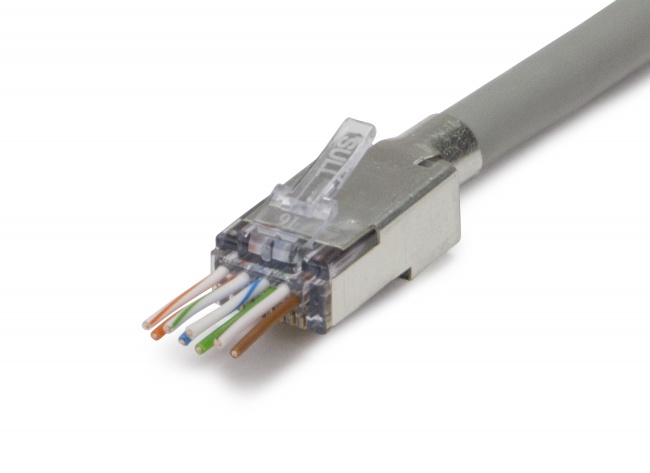
For shielded cable, the equivalent product is the Cat6A/7 Shielded RJ45. It uses the same wire channel sizing as the ezEX48 (1.20mm max) but adds a metallic shield housing and a drain wire termination point. The shield housing makes contact with the cable's foil or braid when crimped, providing the continuous ground path that shielded cabling requires.
If you are working with Cat6A UTP, ezEX48 is the right choice. If you are working with Cat6A or Cat7 shielded cable, the Cat6A/7 Shielded is the right choice. The non-shielded ezEX48 will physically fit on shielded cable but will not provide the shield termination, which defeats the purpose of using shielded cable in the first place.
For a deeper look at when shielded cabling actually matters, read Shielded vs Unshielded Connectors: When Shielding Matters.
Common Mistakes With ezEX Connectors
Buying ezEX44 for a Cat6A job
This is the most expensive mistake. You order a bag of 100 ezEX44s, get to the job site, and discover that the Cat6A conductors will not feed through the wire channels. Now you are sitting on a bag of unusable connectors and need to source ezEX48s before you can work. Verify the cable spec before ordering.
Assuming all Cat6 fits ezEX44
Most Cat6 fits ezEX44, but not all. Some plenum-rated Cat6 and some imported Cat6 use thicker insulation that pushes into the ezEX48 range. If you are working with cable from an unfamiliar source, measure first.
Using a Clamshell crimper
The original Clamshell EZ-RJ45 Crimp Tool predates the ezEX line. Its die geometry does not match the ezEX connector body. Forcing an ezEX into a Clamshell crimper will deform the connector housing, misalign the contact blades, and ruin the termination. If you are moving from EZ-RJ45 to ezEX, you need to upgrade the tool.
Not trimming the separator on Cat6A
Cat6A cable has a plastic spline or tape wrap separator inside that takes up space. After stripping the jacket, this separator must be trimmed flush. Leaving the separator full-length pushes the conductors out of position inside the connector and prevents proper alignment with the wire channels.
For a deeper troubleshooting guide on Cat6A specifically, see Why Your Cat6A Crimps Keep Failing.
Decision Flow: Which Connector to Order
- Working with Cat5e or known-thin Cat6? ezEX44 is the precise fit. Slightly tighter wire channels can give better wire alignment for these smaller conductors.
- Working with Cat6A? ezEX48 is required. The ezEX44 will not accept Cat6A conductors.
- Mixing cable types or unsure? ezEX48. One connector that handles everything.
- Working with shielded cable? Neither standard ezEX. Use the Cat6A/7 Shielded instead.
- Need both unshielded and shielded coverage? Stock both ezEX48 and Cat6A/7 Shielded. They cover the full range of UTP and STP installations.
Related Reading
Background articles that connect to the ezEX44 vs ezEX48 decision:
- EZ-RJ45 vs ezEX Connectors: Which Do You Need? Covers why the ezEX line was introduced as the successor to the original EZ-RJ45.
- Cat6 vs Cat6A: What's the Difference? Explains the cable differences that drive the connector choice.
- Why Your Cat6A Crimps Keep Failing Troubleshooting guide for Cat6A termination problems.
- EXO Crimp Frame vs EZ-RJ PRO HD Tool-side comparison for the high-end crimpers.
- RJ45 Connector Types Explained Full taxonomy of RJ45 connector variants.
Recommended Products
The connector and tool combinations that handle the full ezEX44/ezEX48 termination workflow.
ezEX Pass-Through Connectors
Pick the connector size that matches your cable's conductor diameter
ezEX44 for standard Cat6. ezEX48 for Cat6A and the universal default. Cat6A/7 Shielded for STP cable runs.
Compatible Crimp Tools
Both connector sizes use the same crimp die and trim blade
The EzEX Crimp Tool is purpose-built for the family. The PTS PRO is the universal choice. The Termination Kit bundles tools with starter connectors.
Stripping and Testing
Clean strips and verified terminations
Strip clean, then verify wire map and length on the finished link with the MapMaster.
Frequently Asked Questions
What is the difference between ezEX44 and ezEX48?
The 44 and 48 refer to the maximum insulated conductor diameter the connector accepts in tenths of a millimeter. ezEX44 fits conductors up to 1.10mm, which covers most Cat6 cable. ezEX48 fits conductors up to 1.20mm, which is required for Cat6A cable with thicker insulation. Both are pass-through connectors and both crimp with the same tools.
Can I use ezEX48 connectors on Cat6 cable?
Yes. The ezEX48 accepts conductors from approximately 0.95mm up to 1.20mm, so Cat6 conductors fit fine. The ezEX48 is the universal choice if you only want to stock one connector for both Cat6 and Cat6A. The slightly larger wire channels do not hurt Cat6 performance.
Will ezEX44 work on Cat6A cable?
Usually no. Cat6A cable typically uses 23 AWG conductors with thicker insulation that measures 1.15mm to 1.20mm in diameter, which exceeds the 1.10mm maximum of the ezEX44 wire channels. The conductors will jam halfway through the connector and refuse to pass through the front. Use the ezEX48 for Cat6A.
How do I measure my cable insulated conductor diameter?
Strip the jacket, separate one pair, and measure the diameter of a single insulated conductor using calipers. Do not measure the bare copper. Measure the wire including its colored insulation. If you are below 1.10mm, ezEX44 fits. If you are between 1.10mm and 1.20mm, use ezEX48.
Do ezEX44 and ezEX48 use the same crimp tool?
Yes. Both connectors use the same crimp die geometry and trim blade position. The EzEX Crimp Tool, the EzEX Termination Kit tool, and the PTS PRO Universal all crimp both ezEX44 and ezEX48 connectors with the same setting. There is no die change between the two.
Get the Right ezEX Connector
Stock the connector that matches your cable. ezEX44 for standard Cat6, ezEX48 for Cat6A, Cat6A/7 Shielded for STP runs. All three terminate with the same crimp tool.