The Quick Answer
The four twisted pairs inside a single cable should all be the same physical length, give or take an inch or two. They are extruded together, jacketed together, and pulled together. Yet a cable tester will sometimes report wildly different lengths for each pair. That difference, called pair length skew or delay skew, is one of the more useful pieces of diagnostic information a tester provides — once you know how to interpret it.
What "Length" Means on a Cable Tester
A cable tester does not physically measure the cable. It measures the time delay of a test signal traveling from the tester to the far end and back. Knowing the velocity of propagation (VoP) of the cable, the tester converts that time to a distance. This is the same time-domain reflectometry principle described in How to Find a Broken Cable with TDR.
For each pair, the tester sends a pulse and waits for a reflection. The reflection comes from whatever discontinuity is at the far end of that pair — typically the open end of an unterminated cable, the input of a connected device, or a fault somewhere along the run.
If all four pairs are healthy and end at the same physical location, all four reflections come back at the same time, and all four pairs show the same length. If one pair has a fault that reflects the signal sooner, that pair appears shorter than the others. If one pair has an unusually slow signal because of a stretched conductor or unusual VoP, that pair appears longer.
What Causes Length Mismatch
There are five common causes of pair length mismatch. Most are easy to identify once you know what to look for.
An open or break on one pair
The most common cause. One conductor in the cable is broken or not connected. The tester sees the break as a reflection point and reports that pair's length as the distance to the break. The other three pairs are intact, so they report the actual cable length.
Example: A 30-meter cable shows pairs 1-2, 3-6, and 7-8 at 30 meters but pair 4-5 at 18 meters. The break in pair 4-5 is 18 meters from the test point. Walk the cable from the test point and inspect at the 18-meter mark for damage.
Wrong velocity of propagation setting
Sometimes the cable is fine but the tester is configured with a VoP that does not match the cable. All four pairs will read the same wrong length, off by the percentage that VoP differs from actual. Check the cable type setting on your tester. For Cat6 cable typical VoP is 0.69. For Cat6A it is closer to 0.71. Setting Cat5e VoP for a Cat6A cable can give length errors of a few percent, which can look like a problem when there is none.
Stretched or damaged conductor
If a cable was pulled too hard during installation, individual conductors can stretch. Stretched conductors have slightly different VoP than the original spec. The pair containing the stretched conductor reads longer than the others, even though the physical cable length is the same. This is rare but possible after installations where pull tension limits were exceeded.
Mid-cable splice
A cable that has been spliced or coupled in the middle has impedance discontinuities at the splice. Depending on how the splice was done, individual pairs may see different reflection patterns at the splice point. If you see multiple length steps in the same pair, suspect a splice.
Manufacturing defect
Cable manufacturers can occasionally release product with internal pair length variations. This is uncommon with reputable manufacturers but does happen, especially with bulk cable from unknown sources. If multiple cables from the same spool show the same pattern of pair length differences, the cable itself may be the problem.
Diagnostic Steps
When you see a length mismatch, work through these steps in order.
- Confirm the VoP setting. Check that the tester is set for the right cable type (Cat5e, Cat6, Cat6A, etc.). If you have a known-good cable of the same type and known length, run it through the tester to confirm the reading matches reality.
- Identify the mismatched pair. Look at all four reported lengths. The pair that does not match the others is the suspect.
- Determine if it is shorter or longer. Shorter usually means a break or open at the reported distance. Longer is rare and usually points to VoP issues or a stretched conductor.
- Test from the other end. Disconnect both ends, move the tester to the other end of the cable, and re-test. If the mismatched pair is now shorter from this side too, the fault is somewhere in the middle. The two distances together should pinpoint the fault location.
- Check the wire map. Run a wire map test on the same pairs. If the mismatched pair shows an open, you have your answer.
- Re-terminate the suspect end. If the fault distance is small (within a meter or two of one end), it is at the connector. Re-terminate that end and re-test.
- If re-termination does not fix it, replace the cable. Mid-cable faults cannot be reliably repaired. The run needs to be pulled and replaced.
How to Read Length Mismatch Patterns
Different fault types produce characteristic length report patterns. Recognizing the pattern speeds up diagnosis.
| Length Pattern | Likely Cause | Fix |
|---|---|---|
| 3 pairs at full length, 1 pair much shorter | Open on one pair at the reported distance | Re-terminate end nearest to fault distance |
| 3 pairs at full length, 1 pair much longer | Stretched conductor or VoP error | Verify VoP setting; replace if confirmed |
| 2 pairs short, 2 pairs at full length | Both wires of one pair broken at same point (cable damage) | Identify damage location, replace cable |
| All pairs at the same wrong length | Wrong VoP setting in tester | Set correct cable type; re-test |
| All pairs slightly different (within 2 feet) | Normal manufacturing variation | No action needed; within spec |
| 1 pair short with multiple step changes | Splice or coupler in mid-cable | Locate splice, replace with continuous cable |
| All pairs report length much shorter than expected | Cable break partway through, all pairs at same point | Use TDR to confirm, replace cable |
Delay Skew and the TIA Specification
TIA-568 specifies a maximum delay skew (the time difference between the fastest and slowest pair reaching the far end) of 50 nanoseconds across a 100-meter channel. This converts to roughly 30 to 35 feet of effective length difference at typical Cat6 VoP.
This sounds generous, but it is the maximum allowed before performance issues appear. In practice, properly installed cable from reputable manufacturers shows pair length differences of less than 2 feet over a 100-meter run. Anything beyond a few feet warrants investigation, even if technically within the TIA limit.
When Length Mismatch Is Not a Fault
Not every length mismatch is a defect. Some differences are within the normal range of cable manufacturing tolerances or test instrument resolution.
Inter-pair length differences within a few feet
Different pairs in the same cable use slightly different twist rates. The blue pair, the orange pair, the green pair, and the brown pair each have their own twist rate. Tighter twists make a pair electrically longer, which is intentional — different twist rates between pairs reduce crosstalk. The result is that even a perfectly manufactured cable can show pair length differences of 1 to 3 feet over a 100-meter run. This is normal.
VoP variation across pairs
Some testers measure VoP per pair rather than using a single value. Subtle differences in dielectric properties between pairs can produce small reported length differences even when physical lengths are identical. Cross-check with a different tester if you suspect instrument behavior.
Patch cord versus permanent link
If you are testing a channel that includes patch cords, slight differences between the patch cord at end A and end B can show up as pair length variations. Test the permanent link separately to remove this variable.
Tools for Diagnosing Length Mismatch
You need a tester that reports pair length individually, not just total cable length. Basic continuity testers do not provide this information. Reading delay skew in nanoseconds is a certifier measurement and we do not sell a certifier, but per-pair length gets you to the same answer in the field: four pairs inside one jacket that differ by more than a few feet have a fault in them, and the fault is what you came to find.
Wire Map and Length Tester
Shows wire map plus length per pair, the minimum needed to diagnose mismatch.
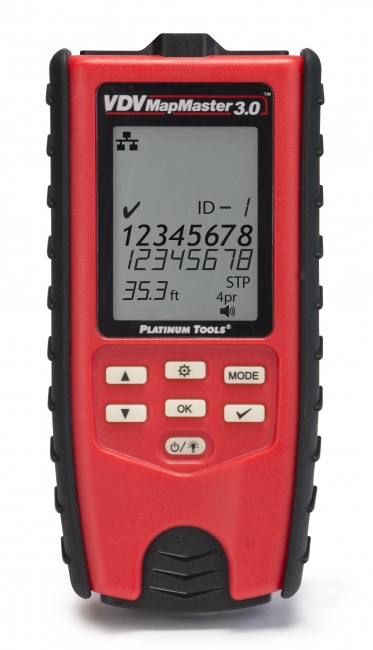
The MapMaster reports per-pair length and distance to fault. For most diagnostic work this is sufficient. The LANSeeker covers wire map and basic length for a lower-cost option.
Termination Tools
For when the diagnosis is "re-terminate the suspect end."
Most length mismatches that resolve with action resolve through re-termination. The right crimp tool and pass-through connectors get the new termination right the first time.
Related Articles
Frequently Asked Questions
What is a cable length mismatch?
A cable length mismatch is when the four pairs in a single cable show significantly different electrical lengths on a tester. Because all four pairs run inside the same cable jacket, they should all measure within a foot or two of each other. A larger difference (called pair length skew or delay skew) usually means a pair has a fault that is reflecting the test signal back early, or a stretched or damaged conductor.
What causes pair length skew on a cable tester?
The most common cause is an open or break partway through one pair. The tester measures the distance to the open as the pair's length, which appears shorter than the other pairs. Other causes include wrong velocity of propagation settings, damaged or stretched conductors, mid-cable splices that affect one pair, and rare manufacturing defects in the cable itself.
How much length difference between pairs is acceptable?
TIA-568 specifies a maximum delay skew of 50 nanoseconds across the four pairs in a 100-meter Cat6 channel, which translates to roughly 30 to 35 feet of length difference at typical velocity of propagation. In practice, properly installed cable shows pair length differences of less than 5 feet. Anything more than 10 feet of difference between pairs in the same cable warrants investigation.
How do I fix a cable length mismatch?
First, determine which pair is mismatched and where the fault is. If the tester shows the bad pair as much shorter than the others, the fault is at the reported distance. Re-terminate that end and re-test. If the fault is mid-cable, the cable needs to be replaced. If all pairs report the same wrong length, check the velocity of propagation setting on your tester.
Will a length mismatch cause my network to fail?
It depends on the severity. A small mismatch (a few feet) generally has no operational impact. A large mismatch usually means one pair has an open or short, in which case the cable will either negotiate down to a slower speed or fail entirely. Length skew within the TIA spec does not cause failures, but length differences caused by faults definitely do.
Find the Real Length, Find the Fault
Per-pair length measurement is one of the fastest ways to localize a cable fault. Browse testers that report length per pair and termination tools to fix what they find.