Quick Answer
A low voltage installer's toolkit is not a single purchase - it is something you build over time as your work demands change. But the core tools are the same whether you are pulling your first residential drop or wiring a 500-port commercial building. The difference is the tier you buy at and the specializations you add.
This guide breaks down every tool category, separates the essentials from the nice-to-haves, gives you three budget tiers to build from, and recommends specific products where CrimpShop carries the right tool for the job.
Termination Tools: Crimpers and Punch-Down Tools
Termination tools make the physical connections. This is where your tool investment has the most direct impact on the quality of your work. A bad crimp tool produces unreliable terminations regardless of technique, while a good one makes clean, consistent connections even on long days.
Crimp tools
Your crimp tool must match your connector type. A tool designed for standard RJ45 plugs will not properly crimp pass-through connectors, and an EZ-RJ45 tool will not handle ezEX connectors. Match the tool to the connector, not the cable category.
Starter Crimper
Affordable entry point for pass-through crimping. Handles EZ-RJ45 Cat5/5e and Cat6 connectors. Compact clamshell design works well for occasional use and smaller jobs.
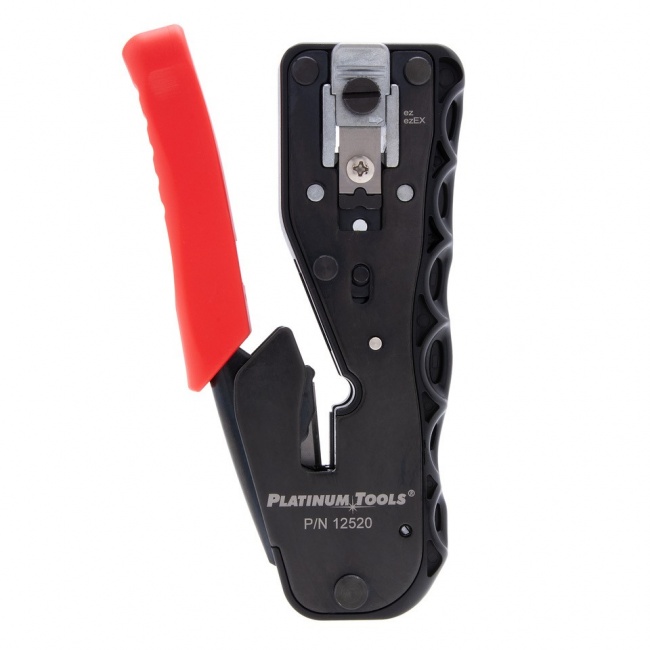
Professional Crimper
The EzEX handles the entire EZ-RJ45 and ezEX connector family including Cat6A.
Universal Crimper
One tool for EZ-RJ45, ezEX, and standard RJ45/RJ12/RJ11 connectors. If you encounter a mix of connector types on the job, the PTS PRO eliminates the need to carry multiple crimpers.
Punch-down tools
Punch-down tools seat wires into insulation displacement contacts (IDCs) on keystone jacks, patch panels, and 66/110 blocks. Every structured cabling job uses them. A spring-loaded impact tool with interchangeable blades covers all standard punch-down types.
Professional Punch-Down
Interchangeable 110, 66, and Krone blades with adjustable impact force. One tool covers keystone jacks, patch panels, and legacy telephone blocks. The carrying case keeps blades organized and protected.
Cable Prep Tools: Strippers and Cutters
Cable prep tools prepare the cable for termination. A clean strip and a square cut are the foundation of every good termination. Nicked conductors cause intermittent failures that are difficult to diagnose, and an uneven cut makes it harder to seat wires in the connector.
Cable jacket strippers
The jacket stripper removes the outer cable jacket without damaging the twisted pairs inside. Adjustable blade depth is the key feature - set it once for your cable type and every strip is consistent.
Budget Stripper
Preset blade depth for Cat5/Cat6 cable. Simple, reliable, and pocket-sized. A great starter stripper that does one thing well.
Multi-Cable Stripper
Adjustable blade depth handles Cat5e through Cat6A, plus coax and speaker wire. One stripper for every cable type you encounter on a low voltage job.
Cutters
You need two types of cutters: flush-cut side cutters for trimming conductors to length, and a cable cutter for cleanly cutting through jacket and conductors together. Most crimp tools include a basic cable cutter, but a dedicated pair of flush cutters gives you cleaner, more precise cuts when trimming wire pairs before insertion into connectors or keystone jacks.
Testing Tools: Cable Testers and Tone Generators
Testing tools tell you whether your termination actually works. Every cable you terminate should be tested - not some, not most, all of them. A wire that looks properly seated can still have a marginal contact, a split pair, or a pin swap that is invisible to the naked eye.
Cable testers
Cable testers range from pocket wire map testers to speed certifiers that cost more than the rest of your bag combined. The tier you need depends on your accountability level: DIY and residential work can get by with a wire map tester, professional installs need qualification testing, and commercial contracts often require certification. Our catalog covers the first two tiers. A speed certifier, and the TIA certifier above it, are instruments we do not sell, and the two cards below are the whole of what we can put in your hand.
Essential: Wire Map Tester
One-button pass/fail testing. Catches opens, shorts, and miswires. Every installer should own at least this level of tester. If you crimp connectors, you test connectors.
Professional: Qualification Tester
The VDV MapMaster adds length measurement, distance-to-fault, multi-location testing, and a shield continuity check for shielded runs. This is the tester most professional installers should be carrying.
Tone generators and probes
Tone generators identify specific cables in bundled runs. Clip the toner to one end, scan with the probe at the other. Essential for troubleshooting existing installations and identifying unlabeled cables in walls and ceilings.
Tone & Probe Kits
The Digital Tone & Probe Kit works on live and dead cable, so you can trace a run without unplugging it, and its adjustable volume and multiple tone patterns cut through the electrical noise of a commercial building.
PoE testers
If you work with IP cameras, wireless access points, or VoIP phones, a PoE tester quickly identifies power delivery issues without pulling out a laptop or logging into a switch. It plugs into the port and reads the standard, the voltage, and the wattage, which tells you in seconds whether the problem sits upstream or downstream of where you are standing. This is one tool we do not stock, so plan to source it elsewhere. Our PoE tester guide covers how to read the results.
Installation Tools: Pulling, Routing, and Fastening
Installation tools get cable from point A to point B. These are the tools that make the physical work of running cable faster, cleaner, and less frustrating. You can improvise without them, but you will be slower and more prone to damaging cable.
Cable pulling
- Fish tape (steel or fiberglass) - Routes cable through walls, ceilings, and conduit. Steel fish tape works in straight runs and conduit. Fiberglass is lighter and safer around electrical wiring.
- Glow rods - Luminescent fiberglass rods that snap together for pushing cable across open ceiling spaces. Easier than fish tape for horizontal runs above drop ceilings.
- Cable pulling lubricant - Reduces friction when pulling cable through long conduit runs. Prevents jacket damage and makes pulls easier on both the cable and you.
- Pull string/mule tape - Pre-routes through conduit so you can pull cable without fish tape on future runs. Install it on every conduit pull for next time.
Drilling and routing
- Installer drill bits (flex bits) - Long, flexible bits designed to drill through studs and joists from inside a wall cavity. Typically 54 to 72 inches long with a hole in the tip for pulling cable back through.
- Hole saws - Cut clean openings for low voltage brackets, conduit entries, and cable pass-throughs. A set covering 3/4" to 2" handles most LV work.
- Low voltage brackets (old work) - Mount in existing drywall without a junction box. Required for every wall plate installation in existing construction.
Fastening and support
- Cable staples (T-style or round) - Secure cable runs along studs and joists. Use insulated staples rated for data cable to avoid crushing the pairs.
- J-hooks and cable hangers - Support cable runs in open ceiling spaces and cable trays. Required for commercial installs to maintain proper cable bend radius and support intervals.
- Velcro cable ties (not zip ties) - Bundle and manage cable runs. Velcro is reusable and does not risk crushing cables the way over-tightened zip ties can. Use hook-and-loop for data cable, always.
Organization Tools: Labels, Storage, and Documentation
Organization tools keep your work professional and your toolkit functional. Labeling saves hours of troubleshooting on future service calls. A good tool bag means every tool has a place and you never waste time searching.
- Cable labels / label maker - Label every cable at both ends. A handheld label maker with cable wrap labels is the professional standard. Self-laminating labels survive years in ceilings and walls.
- Cable ties and Velcro wraps - Keep cable bundles neat in panels and enclosures. Use Velcro in any location where cables might need to be rearranged later.
- Tool bag or tool pouch - A dedicated electrician-style tool bag with multiple pockets keeps your most-used tools accessible. Look for a bag with a wide, stable base that stays open when set down.
- Cable run documentation sheets - Track what you pulled, where it runs, and what it is labeled. Even a simple spreadsheet saves you and the next technician significant time.
Essential vs Nice-to-Have
Not every tool needs to be in your bag on day one. Here is a clear split between what you absolutely need and what you can add as your work grows.
Essential (Buy First)
- Crimp tool matched to your connector type
- Cable jacket stripper
- Flush-cut side cutters
- Wire map cable tester
- Punch-down tool with 110 blade
- Screwdriver set (Phillips and flat)
- Tape measure
- Flashlight / headlamp
- Cable labels
- Electrical tape
Nice-to-Have (Add Over Time)
- Tone generator and probe
- PoE tester
- Fish tape / glow rods
- Installer drill bits
- Qualification cable tester (upgrade from wire map)
- Label maker with cable wrap labels
- Cable pulling lubricant
- Inspection camera / borescope
- Low voltage bracket kit
- Qualification tester (to prove runs carry traffic without errors)
Budget Tiers: Build Your Kit at Any Level
Three budget tiers, each one building on the last. Start where your budget allows and upgrade as your work demands it.
Starter Kit
$150 - $300Everything you need for basic residential installations and DIY network drops.
- Clamshell EZ-RJ45 Crimp Tool - $37.46
- Cat5/6 Cable Jacket Stripper - $12.81
- LanSeeker Cable Tester - $80.08
- EZ-RJ45 Cat5/5e Connectors - $33.19
- Flush-cut side cutters - $10-$20
- Screwdriver set - $15-$25
- Electrical tape and cable labels - $10-$15
CrimpShop items in this list: $163.54. The remaining lines are general tools you can source anywhere.
Professional Kit
$500 - $800Covers commercial structured cabling with proper testing, documentation, and the right tools for Cat6A work.
- EzEX Crimp Tool - $106.65
- Multi-Strip Cable Stripper - $25.33
- VDV MapMaster 3.0 - $168.14
- PRO Punchdown Kit - $89.96
- ezEX48 Cat6A Connectors - $84.85
- Fish tape, drill bits, tool bag - $100-$150
CrimpShop items in this list: $474.93. The remaining line is general tools you can source anywhere.
Fully Loaded
$600+The deepest kit we can supply: tone tracing for existing infrastructure, shielded Cat6A terminations, and the accessories that turn a tool bag into a working van.
- Multi-Strip Cable Stripper - $25.33
- Digital Tone & Probe Kit - $202.66
- PRO Punchdown Kit - $89.96
- ezEX48 Cat6A Connectors - $84.85
- Strain Reliefs Cat6 - $14.30
- Fish tape, glow rods, drill bits, label maker, pro tool bag - $200+
CrimpShop items in this list: $417.10. The remaining line is general tools you can source anywhere.
For a 10-gig focused kit:
10Gig Termination Kit - $303.91 →Building Your Kit by Job Type
Different jobs demand different tool emphases. Here is how to prioritize your toolkit based on the type of work you do most.
Residential
Home networking, media rooms, security cameras, and smart home wiring. Most work is Cat5e and Cat6 with shorter runs.
Prioritize: A reliable pass-through crimp tool, a basic wire map tester, fish tape for wall runs, and installer drill bits. A tone generator helps when working in existing homes with unlabeled cable.
Recommended starting point: ezEX Starter Kit ($143.23) plus a LanSeeker ($80.08). The kit is the least expensive way to own the EXO Crimp Frame, the same frame listed in the Professional tier, and it arrives with 100 ezEX connectors covering Cat5e, Cat6 and Cat6A plus 20 strain reliefs. It does not include a jacket stripper, so add a Cat5/6 jacket stripper ($12.81).
Commercial
Office buildings, retail spaces, and multi-tenant environments. Structured cabling with patch panels, cable management, and client documentation requirements.
Prioritize: A professional-grade crimp tool, a qualification tester that measures length and identifies drops by number, a punch-down kit with multiple blade types, and a tone generator for troubleshooting existing infrastructure. Labeling tools are essential for commercial work.
Recommended starting point: EzEX Crimp Tool ($106.65) plus a VDV MapMaster 3.0 ($168.14) and a PRO Punchdown Kit ($89.96).
Data Center
Server rooms, network closets, and high-density patching environments. Cat6A and shielded cable with 10-gig performance requirements.
Prioritize: A crimp tool rated for Cat6A connectors, shielded connectors, and precision cable prep tools. Every termination needs to be tested and documented, and on 10-gig work the instrument that signs off on it is a certifier you will be renting or buying elsewhere.
Recommended starting point: 10Gig Termination Kit ($303.91), and budget separately for certification.
Tool Maintenance and Care
Low voltage tools are precision instruments. A crimp tool with a worn die produces inconsistent crimps. A cable tester with corroded contacts gives false readings. Basic maintenance extends tool life and protects your work quality.
- Keep crimp tool dies clean. Wipe dies after each job with a dry cloth. Conductor fragments accumulate in the die and prevent full crimps. Compressed air removes stubborn debris.
- Oil the ratchet mechanism. A drop of light machine oil on the ratchet pivot point every few months keeps the crimp cycle smooth and consistent.
- Protect test equipment contacts. Store cable testers with the dust caps on the RJ45 ports. Corroded or bent test ports produce intermittent false failures that undermine your confidence in results.
- Replace stripper blades when they dull. A dull blade tears the jacket instead of cutting it, which risks nicking conductors. Most strippers have replaceable blade cartridges - carry a spare.
- Store tools dry. Moisture in tool bags leads to corrosion on steel components and unreliable connections on test equipment. If your tools get wet on a job, dry them before putting them away.
- Check calibration on testers. If your cable tester starts producing inconsistent results on cables you know are good, the test adapters may need cleaning or replacement. Some higher-end testers have a self-test mode for verification.
Common Toolkit Mistakes
These mistakes are expensive in time, money, or both. Avoid them from the start and you skip the learning curve that costs most installers their first few jobs.
Complete Low Voltage Tool Checklist
The full list, organized by category. Check off what you have and use the priority column to decide what to buy next.
| Category | Tool | Priority | Budget |
|---|---|---|---|
| Termination | Crimp tool (matched to connectors) | Essential | $40 - $85 |
| Termination | Punch-down tool with 110 blade | Essential | $25 - $90 |
| Termination | RJ45 connectors (matched to cable) | Essential | $10 - $23 |
| Cable Prep | Cable jacket stripper | Essential | $15 - $25 |
| Cable Prep | Flush-cut side cutters | Essential | $10 - $20 |
| Testing | Wire map tester | Essential | $50 |
| Testing | Tone generator & probe | Recommended | $60 - $90 |
| Testing | PoE tester | Recommended | $80 |
| Testing | Verification tester | Upgrade | $150 - $450 |
| Installation | Fish tape (steel or fiberglass) | Recommended | $30 - $80 |
| Installation | Installer drill bits (flex bits) | Recommended | $25 - $60 |
| Installation | Low voltage brackets (old work) | Recommended | $10 - $20 |
| Installation | Cable staples (insulated) | Recommended | $5 - $15 |
| Organization | Cable labels / label maker | Essential | $10 - $50 |
| Organization | Velcro cable ties | Essential | $5 - $15 |
| Organization | Tool bag / pouch | Recommended | $30 - $80 |
| General | Screwdriver set (Phillips + flat) | Essential | $15 - $25 |
| General | Tape measure | Essential | $10 - $25 |
| General | Flashlight / headlamp | Essential | $15 - $40 |
Frequently Asked Questions
What tools do I need to start as a low voltage installer?
At minimum, you need a crimp tool matched to your connector type, a cable jacket stripper, a wire map tester, a punch-down tool for keystone jacks and patch panels, flush-cut side cutters, and a screwdriver set. You can build a functional starter kit for $150 to $300 that covers residential work. Add a tone generator, fish tape, and a better cable tester as your jobs grow.
Should I buy a tool kit or buy tools individually?
Kits like the ezEX Starter Kit are the best value when you are starting out because they bundle compatible tools at a lower combined price. As you specialize, buying individual tools lets you pick exactly the right tool for your connector system and cable type. Most professionals start with a kit and then replace individual pieces with better versions over time.
What is the difference between a crimper and a punch-down tool?
A crimper attaches RJ45 plugs to the end of cable for patch cables and device connections. A punch-down tool seats individual wires into insulation displacement contacts (IDCs) on keystone jacks, patch panels, and 66/110 blocks. Most structured cabling jobs require both: punch-down tools for permanent wall jacks and patch panels, and crimpers for custom patch cables and direct connections.
Do I need different tools for Cat5e, Cat6, and Cat6A?
Strippers and testers generally work across all categories. Crimpers and connectors are where compatibility matters. A crimp tool designed for standard RJ45 connectors will not properly crimp ezEX connectors designed for Cat6A. Always verify that your crimp tool matches your connector type. Punch-down tools are universal across cable categories.
How much should I spend on low voltage tools?
A starter kit for residential work runs $150 to $300. A professional kit for commercial structured cabling runs $500 to $800. Past that you are buying premium tools, more connector variety, and better cable prep, which is where a toolkit crosses $1,000. Speed certification and TIA certification instruments are a separate purchase from a separate supplier and are not counted in any of those figures. Buy the best crimp tool and cable tester you can afford first - those two tools have the biggest impact on the quality of your work.
Build Your Low Voltage Toolkit
Browse our full range of termination tools, cable testers, strippers, and professional kits. Everything you need to build the toolkit that matches your work.