The Quick Answer
If you have done office cabling and you are about to do hospital work, the biggest adjustment is procedural: you do not just walk into a patient floor with a ladder and a spool of cable. Every step is governed by infection control, life safety, and HIPAA security requirements. Plan accordingly or your job will not start on time.
Cable Category and Jacket Specifications
Hospital specifications are typically more conservative than office specifications because the network supports clinical systems and the cable needs to last through multiple equipment refreshes.
Cat6A Is the Hospital Standard
Cat6A supports 10GBASE-T at the full 100-meter channel length, which is necessary for medical imaging traffic. PACS (Picture Archiving and Communication Systems) move large image files between modalities, archives, and viewing workstations. CT, MRI, and digital radiography all generate large datasets that need to traverse the network in seconds, not minutes. Cat6A handles current and projected imaging bandwidth.
Shielded Cable in Critical Areas
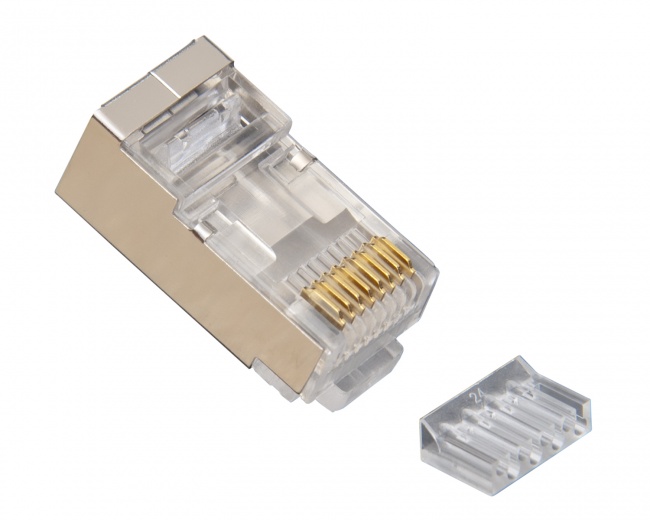
Imaging suites, operating rooms, and biomedical equipment areas often specify shielded Cat6A (F/UTP or S/FTP) to mitigate electromagnetic interference from medical equipment. MRI suites are particularly demanding because of the strong magnetic fields and the proximity to high-frequency RF systems. Read our guide on how to terminate shielded STP cable for the technique. The Cat6A/7 shielded connectors handle 360-degree shield termination, which is required for proper EMI rejection.
Plenum and LSZH Jacket Requirements
NEC Article 800 requires plenum-rated cable in plenum air spaces, which covers most ceiling plenums in hospital construction. Beyond NEC, hospital specifications often go further: NFPA 99 Health Care Facilities Code drives stricter fire and smoke control, and many hospitals specify low-smoke zero-halogen (LSZH) jacket compounds for reduced toxicity during a fire. CMP-LS (limited smoke) cable is a common spec in hospital projects.
HIPAA and Network Segmentation
HIPAA does not directly specify cable types, but the Security Rule's physical safeguards and the practical requirements of clinical network segmentation drive cabling design decisions.
Physical Safeguards
HIPAA Security Rule 164.310 requires that workstations and electronic media containing PHI be physically secured. For cabling, this translates to:
- Locked telecom rooms. All MDF and IDF spaces must have locking doors and access logging. Card access with audit trails is the standard for hospital telecom rooms.
- Inaccessible pathways. Cable pathways that cross publicly accessible areas should be physically secured, typically by routing above the ceiling or in conduit.
- Workstation cabling. Wall outlets in patient-accessible areas (waiting rooms, treatment rooms) should not provide direct access to administrative or clinical VLANs without authentication at the switch port.
Network Segmentation at the Patch Panel
Hospital networks are heavily segmented: clinical (EHR, PACS, lab systems), administrative (back office, HR, finance), guest Wi-Fi, biomedical equipment, building automation, security cameras, and IP telephony each typically run on separate VLANs. Many hospitals physically separate critical clinical networks from administrative networks at the patch panel level: dedicated patch panels for clinical drops, distinct color coding, and separate switch hardware. This makes accidental cross-connection nearly impossible.
Documentation and Audit Trails
HIPAA requires documented access controls and audit trails. Cabling supports this by making the network topology auditable: every drop is labeled, every patch panel port is documented, and every change is logged. The TIA-606 labeling scheme is not optional in a hospital environment. Without it, the IT security team cannot prove which cable serves which device, which makes HIPAA audits painful.
ICRA Infection Control Requirements
Infection Control Risk Assessment (ICRA) is the framework that governs construction and renovation activity in healthcare facilities. Before you touch a ceiling tile in an occupied hospital, you go through ICRA.
ICRA Classes
| Class | Activity Type | Typical Cabling Work |
|---|---|---|
| Class I | Inspection, non-invasive activities | Visual inspection, non-disruptive changes |
| Class II | Small-scale, short-duration work creating minimal dust | Single drop addition, faceplate changes |
| Class III | Work generating moderate to high levels of dust | Pulling cable through ceiling, multiple drops |
| Class IV | Major demolition and construction | New IDF construction, major pathway installation |
Practical ICRA Compliance for Cabling Crews
Most hospital cabling work falls into Class II or Class III. The required controls include:
- Negative pressure barriers. Sealed plastic walls or HEPA-filtered work zones around the active work area to prevent dust from migrating to patient care spaces.
- HEPA vacuums. All dust generated by cable pulls, ceiling tile removal, or drilling must be captured by HEPA-filtered vacuums.
- Dedicated tools. Tools that enter the work zone stay in the work zone for the duration of the work. No carrying tools in and out.
- Decontamination. Workers leaving the work zone must follow decontamination procedures: tacky mats at exits, HEPA-vacuumed clothing, hand hygiene.
- Tile counts and walk-downs. Many hospitals require ceiling tile counts at start of work and end of work to ensure no tiles are damaged or replaced incorrectly.
ICRA Training
Most hospital systems require cabling crews to complete ICRA training before entering occupied facilities. The training covers infection control fundamentals, dust containment procedures, PPE requirements, and emergency response. Certifications are typically valid for 1-3 years and must be on file with the hospital's facilities management department.
Pathway Design and Redundancy
Hospital networks support 24/7 operations with no maintenance windows for critical clinical systems. Cabling pathway design must reflect this uptime requirement.
Diverse-Path Backbone
Fiber backbone runs from each IDF to the MDF should follow physically separate pathways. If a single fire, water leak, or construction accident severs both pathways, the IDF goes offline and dozens of clinical workstations lose network connectivity. Diverse-path means using two distinct routes through the building, ideally on opposite sides of the structure.
Redundant IDF Connectivity
Each IDF should have at least two fiber backbone connections to the MDF, terminated on different uplink switches and powered from different UPS circuits. If one backbone or one uplink switch fails, the IDF stays connected through the second path. This is standard practice for hospital networks and a hard requirement for critical care areas.
UPS and Generator Coverage
All hospital telecom rooms must be on UPS power, and the UPS circuits must be backed by the building generator. Hospitals are required by code to maintain power to life safety and critical care systems during utility outages, and the network supporting those systems is part of that requirement. Coordinate with the electrical contractor to ensure all telecom room outlets are on the appropriate generator and UPS circuits.
Read our data center cable management guide for more on redundant pathway and rack design that applies to hospital MDF/IDF spaces.
Termination and Testing Standards
Hospital projects require full TIA-568 channel certification on every cable, with documented test reports submitted as part of project closeout. There is no shortcutting this step.
Termination Requirements
All horizontal runs terminate on keystone jacks at the work area outlet and on patch panels in the IDF. Use shielded jacks and shielded patch panels for shielded cable runs, with proper drain wire termination at both ends. Read our guide on how to terminate Cat6A for the technique.
For toolkits that match hospital project requirements:
- 10-Gig termination kit with all required tools for Cat6A work
- Cat6A/7 shielded connectors for critical care and imaging areas
- Cat5/6 jacket stripper for clean prep without conductor damage
- VDV MapMaster 3.0 for wire map and length checks during the install, ahead of the certification pass
Certification Documentation
Each cable run requires a full certification report showing insertion loss, return loss, NEXT, PSNEXT, ACR-F, propagation delay, and (for Cat6A) ANEXT. The report must include the test instrument model, calibration date, test date, technician name, cable identification, and pass/fail status. Hospitals often require certification reports to be delivered in a structured format (CSV or vendor-specific) so they can be ingested into the facility's cable management database.
Re-Testing After Equipment Installation
Some hospital specifications require re-testing of cable runs after the network equipment is installed and energized to verify the channel performance under actual operating conditions. This catches issues that emerge from EMI or cross-talk between operating cables that did not appear in the initial certification.
Labeling and Documentation
Hospital cabling labeling must follow TIA-606 and must be machine-readable for the facility's cable management system. The label scheme typically encodes building, floor, room, IDF, and port number.
Label Locations
- Cable jacket. Both ends of every cable, within 2 inches of the termination point. Wrap-around printed labels are standard.
- Wall outlet. Label on the faceplate identifying the cable ID and matching the patch panel port.
- Patch panel port. Engraved or printed label on the patch panel matching the cable ID.
- Pathways. Cable bundles in cable trays should have identifiers at every access point.
As-Built Documentation
Hospital projects require comprehensive as-built documentation including cable schedules, patch panel maps, IDF rack elevations, fiber backbone diagrams, pathway routing drawings, and full certification reports. This documentation becomes the cable management record for the facility and must be delivered in formats the hospital IT department can maintain.
Common Mistakes in Hospital Cabling Projects
- Skipping ICRA training and procedures. Treat ICRA as a hard requirement, not a recommendation. Crews caught working without proper containment in occupied areas will be removed from the project and barred from future work.
- Substituting CMR for CMP cable. Materials cost difference is real, but the spec is the spec. Inspection failures here are project-killers.
- Inadequate network segmentation planning. Mixing clinical and administrative drops on the same patch panel without clear separation creates HIPAA compliance risk and complicates future security audits.
- Single-path backbone fiber. All backbone runs need diverse paths. Co-locating both fiber runs in the same conduit defeats the purpose of redundancy.
- Insufficient documentation. Hospitals will hold final payment until full certification reports, as-built drawings, and labeling documentation are delivered. Build documentation effort into the project timeline from day one.
- Ignoring biomedical equipment isolation. Some biomedical equipment manufacturers require dedicated network segments and may not approve operation on shared networks. Verify isolation requirements for any specialty equipment areas before bidding.
- Not coordinating with infection prevention. The hospital's infection prevention team has authority over construction activities in occupied areas. Coordinate the work plan with them before mobilizing.
Related Articles
Frequently Asked Questions
What network cable category is required for hospitals?
Most hospitals specify Cat6A as the minimum for new construction and major renovations. Cat6A supports 10GBASE-T to the desk, handles the bandwidth required by medical imaging (PACS, MRI, CT), and meets the PoE current demands of clinical Wi-Fi access points and IP telephony. Critical care areas, imaging suites, and operating rooms often specify shielded Cat6A (F/UTP or S/FTP) to mitigate EMI from medical equipment. Cat6 is acceptable only in low-criticality administrative areas.
Does HIPAA dictate network cabling requirements?
HIPAA does not directly specify cable types or installation methods, but the Security Rule's physical safeguards require controls that affect cabling design. Network closets must be locked and access-logged, cable pathways should not be physically accessible to unauthorized personnel, and sensitive systems (PACS, EHR servers) typically run on segmented VLANs with dedicated patch panels and clearly labeled cable runs. The cabling itself supports HIPAA compliance by enabling the network segmentation, physical security, and audit trails that HIPAA requires.
What is ICRA and how does it apply to hospital cabling work?
ICRA (Infection Control Risk Assessment) is the protocol that determines what infection control measures are required during construction and renovation activities in healthcare facilities. Cabling work in occupied patient care areas typically requires Class III or Class IV controls: HEPA-filtered negative-pressure barriers around the work area, sealed plastic walls and ceilings, dedicated tools that stay inside the barrier, and decontamination procedures when leaving the work zone. Workers must complete ICRA training before entering occupied healthcare facilities.
Where is plenum-rated cable required in a hospital?
Plenum-rated (CMP) cable is required in any space used for HVAC air handling, which in hospitals includes most ceiling plenums, mechanical chases, and air-handling shafts. Beyond NEC requirements, hospital specifications typically require plenum-rated cable throughout the entire building because of the strict fire and smoke control requirements in NFPA 99 (Health Care Facilities Code). Many hospitals also specify low-smoke zero-halogen (LSZH) jacket compounds for their reduced toxicity in the event of a fire.
How is hospital cabling tested and certified?
Hospital cabling requires full TIA-568 channel certification with a Fluke DSX or equivalent test instrument. Every cable run must pass insertion loss, return loss, NEXT, PSNEXT, ACR-F, ANEXT (for shielded Cat6A), and propagation delay testing against the appropriate category limits. Test reports are submitted as part of project closeout and become part of the facility's cable management records. Certification reports must show the test instrument calibration date, technician name, test date, and pass/fail status for each measured parameter.
Equip Your Healthcare Cabling Crew
Hospital projects demand shielded Cat6A connectors, certified terminations, and tools that produce consistent results in clean conditions.