- Full distance: Cat6a is qualified for 10GBASE-T over the entire 100 m (328 ft) channel. Cat6 only reaches 55 m, and even that is a guideline, not a guarantee.
- "100 m" is a budget, not a cable order. It's up to 90 m of horizontal cable plus 10 m of combined patch cords — stranded patch cords attenuate ~20% faster than solid horizontal copper.
- Heat is the hidden distance killer. Insertion loss climbs ~0.4% per °C; a bundled PoE++ run in a 40°C plenum burns ~8% of its loss budget before load.
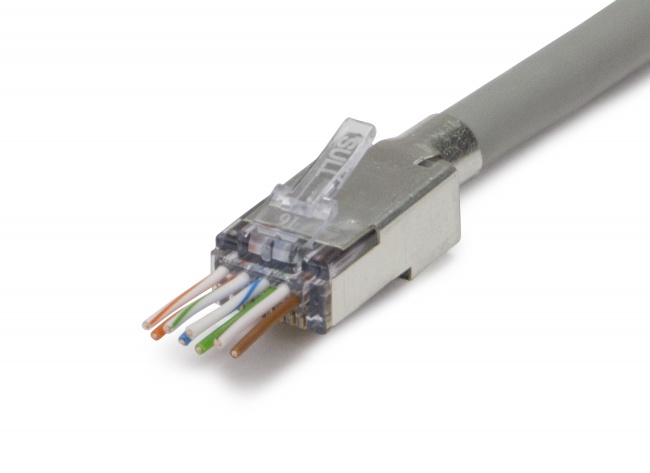
- Termination decides pass/fail at 500 MHz. Use a Cat6a-rated plug like the ezEX48 — a Cat6 connector will not pass 10G on Cat6a.
- Certify, don't assume. A wire-map test does not validate 10G. Run a Level IV+ certifier in channel mode and save the report.
The Short Answer
Cat6a supports 10GBASE-T at the full 100 meter (328 ft) channel length: up to 90 m of horizontal cable plus 10 m of combined patch cords. That figure comes from the ANSI/TIA-568.2-D channel model and is the same length Ethernet has used since 10BASE-T. Cat6 cannot match it. Cat6 is rated for 10GBASE-T only to 55 m (180 ft), and even that figure assumes a benign installation.
If you are deciding whether Cat6a is enough cable for a 10G run, the answer is yes for any conforming channel inside one building. If you are weighing Cat6 against Cat6a in general, the Cat6 vs Cat6a hub covers the broader comparison. This post is the distance drilldown.
| Metric | Cat6 at 10GBASE-T | Cat6a at 10GBASE-T |
|---|---|---|
| Max channel length | 55 m (180 ft) | 100 m (328 ft) |
| Max horizontal cable | 37 m typical | 90 m |
| Max patch cord allowance | 18 m combined | 10 m combined |
| Tested bandwidth | 250 MHz | 500 MHz |
| Alien crosstalk specified | No | Yes (PSANEXT, PSAACRF) |
Why Cat6 Falls Off at 55 m and Cat6a Doesn't
Cat6 was specified before 10GBASE-T existed. When IEEE 802.3an arrived in 2006, the industry found Cat6 would carry 10G only over short channels and only when alien crosstalk between bundled cables was low. The 55 m figure in TIA TSB-155-A is a guideline, not a guarantee. Pull six Cat6 cables tight through a hot ceiling and usable 10G distance can drop well below 55 m.
Alien Crosstalk and the 500 MHz Bandwidth Requirement
10GBASE-T uses signaling out to roughly 400 MHz. Cat6 is characterized only to 250 MHz, meaning the standard has no data on how the cable behaves at the frequencies the application actually uses. Cat6a is characterized to 500 MHz and adds two crosstalk metrics Cat6 omits: power sum alien near-end crosstalk (PSANEXT) and power sum alien attenuation-to-crosstalk ratio, far end (PSAACRF). Those parameters are why Cat6a holds 10G over a full channel and Cat6 does not.
The full comparison hub, covering cost and use-case selection alongside performance, is in Cat6 vs Cat6a.
What ANSI/TIA-568.2-D Actually Specifies
The current generic cabling standard for North America is ANSI/TIA-568.2-D (2018, amended since). The international equivalent is ISO/IEC 11801-1. Both define a Class EA channel for Cat6a qualified for 10GBASE-T at 100 m. The standard does not say "100 meters of cable." It says "100 meter channel," and the distinction matters on every install.
Horizontal vs. Patch Cord Length Limits
A TIA channel has five components: equipment cord, patch cord, horizontal cable, work area cord, and any consolidation point. Horizontal cable is permitted up to 90 m. Combined flexible cords on both ends may total 10 m. If patch cords exceed 10 m, the horizontal allowance drops to compensate. Most certifiers default to 90 m horizontal and 5 m plus 5 m patch.
Why "100 m" Is a Channel Length, Not a Cable Length
Flexible patch cords use stranded conductors, which attenuate roughly 20 percent faster than the solid copper used in horizontal cable. The TIA channel model trades horizontal length against patch cord length on a fixed budget. Treat the 100 m number as a system budget, not a cable order.
Installation Conditions That Reduce Effective Distance
The standard tells you what a clean install can do. The job site tells you what your install will actually do. Several field conditions eat into the 100 m budget.
Bundling, Heat, and PoE Loads
Bundled cables run hotter than loose ones. Cat6a insertion loss rises with temperature at roughly 0.4 percent per degree C above 20 C. A run in a 40 C plenum loses about 8 percent of its loss budget before any other factor. Add PoE++ at IEEE 802.3bt Type 4 (90 W per port) and the conductor heats further under load. See PoE cable requirements.
Pulled Tension and Bend Radius
Cat6a is stiffer than Cat6 and less forgiving of overpull. The pull tension limit is 110 N (25 lbf) for 4-pair cable. Exceeding it deforms the twist geometry, and the damage is not always visible. A run that passes wire map can still fail return loss because the pair geometry was stretched on one pull. Bend radius for unshielded Cat6a is 4 times cable diameter unloaded, 8 times under load. A right-angle bend over a ceiling grid is a return loss failure waiting for a certifier.
Building a run that has to survive heat, bundling, and PoE++? Distance margin lives and dies at the plug. The 10Gig Termination Kit pairs the ezEX48 Cat6a plugs with the EXO crimp frame and the prep tools built for 23 AWG geometry — the difference between a channel that certifies at 100 m and one that fails return loss.
Shop the 10Gig Termination Kit →Weighing the cable choice first? Start with the Cat6 vs Cat6a hub.
Termination Quality Matters at 10G
Connector geometry has more effect on 10G insertion loss and return loss than most installers expect. Cat6a conductors are typically 23 AWG, and the connector must seat that diameter against the contact blades without distorting the pair twist. The Platinum Tools ezEX48 Cat6a connector is the field-terminated plug we recommend for Cat6a 10G work; the passthrough geometry holds the alignment and contact registration that 500 MHz performance requires. A poor termination pulls a 100 m channel out of spec faster than any derating above.
How to Verify a Cat6a Run Will Hit 10G at Distance
A wire map test does not validate 10G. A 10G channel needs a Level IV (or better) field certifier that tests insertion loss, NEXT, PSNEXT, ACRN, ACRF, PSACRF, return loss, propagation delay, delay skew, and both alien crosstalk parameters out to 500 MHz. We do not sell a field certifier, and nothing in our lineup measures those frequency-domain parameters. What our testers do is confirm the run is built and terminated correctly: wire map, length, and distance to fault. That is the half of the job you can settle before the certifier arrives, and it is the half that fails most often.
Run the certifier in channel mode when commissioning a 10G run. Permanent link mode is for the contractor turning over horizontal cable. Channel mode is for the network team commissioning the application. Save the report. It protects the install against future "the network is slow" complaints.
The Cat6a 10G Distance Field Checklist
One printable page that turns the TIA-568.2-D channel budget into a job-site checklist. Pull it out before you certify, tape it inside the tester case, and stop losing 10G runs to heat, bundling, or a skipped cert.
- The 90 m + 10 m channel budget worked out for real installs
- Insertion-loss temperature derating for bundled and PoE++ runs
- The full Level IV+ cert parameter list to demand before sign-off
No spam. Unsubscribe anytime.
When to Drop to a Shorter Run or Move to Fiber
Cat6a is qualified for one building, one channel, 100 m. If a run exceeds 100 m, the answer is not "better cable." It is fiber. A short OM3 multimode run with SFP+ transceivers costs less than fighting a 110 m copper channel out of spec on day one. Inside the 100 m budget, Cat6a is the right spec for any new 10G deployment in a commercial structured cabling system. Outside it, you are designing for failure.
Wrap
The 100 m channel is real, in the standard, and achievable on a competently installed Cat6a run. Most 10G distance problems on Cat6a are termination, bundling, or cert-skipped problems, not cable problems. Spec the right connector, pull inside tension and bend limits, terminate with a plug built for 23 AWG conductors, and certify against the full TIA-568.2-D parameter set. For the broader Cat6 versus Cat6a context, the hub post ties speed, distance, PoE, and cost into one place. For everything needed to terminate and certify a 10G run from scratch, the 10Gig Termination Kit pairs the ezEX48 connectors, the EXO crimp tool, and the prep tools built for Cat6a geometry.
Speccing a 10G run and want a second set of eyes?
Distance, bundle size, PoE class, plenum temperature, and termination choice all interact. If you want a sanity check on a Cat6a 10G design before pulling cable, send the run sheet and we'll review it against TIA-568.2-D parameters.
Ask Us a QuestionFrequently Asked Questions
Can Cat6a run 10G at 100 meters?
Yes. Cat6a is qualified for 10GBASE-T at the full 100 meter (328 ft) channel length under ANSI/TIA-568.2-D. That channel is built from up to 90 m of horizontal cable plus 10 m of combined patch cords on both ends. The 100 m figure is a system budget for the entire channel, not a length of cable you can order.
What is the maximum distance for Cat6 at 10G?
Cat6 is rated for 10GBASE-T only up to 55 meters (180 ft), and that figure is a guideline from TIA TSB-155-A rather than a guarantee. Cat6 is characterized only to 250 MHz, and 10GBASE-T uses signaling out to roughly 400 MHz. Beyond 55 m, signal integrity and alien crosstalk between bundled cables degrade enough that 10G becomes unreliable.
Does PoE reduce Cat6a distance?
PoE does not reduce the 100 m TIA channel length directly, but it heats the conductors and that heat raises insertion loss. Cat6a insertion loss rises roughly 0.4 percent per degree C above 20 C. A bundled run in a 40 C plenum loses about 8 percent of its loss budget before PoE load, and IEEE 802.3bt Type 4 (90 W per port) heats the conductors further. Bundle smaller, derate per TIA TSB-184-A, or move bundles out of hot pathways.
Do I need shielded Cat6a for 10G?
Not for the 100 m specification itself. The TIA-568.2-D channel definition is met by both unshielded (F/UTP, U/FTP) and shielded Cat6a constructions. Shielded Cat6a becomes the right choice in high-EMI environments, parallel runs alongside high-voltage power, and dense bundles where alien crosstalk margin is tight. For a typical commercial install with reasonable separation from power, unshielded Cat6a is rated for 10G at 100 m without a shield.
Build the Run Right
The 100 m channel only happens with the right connector, the right tool, and a cert tester that reports against TIA-568.2-D. The 10Gig Termination Kit pairs the ezEX48 plugs with the EXO crimp frame and the prep tools that hold Cat6a's geometry through termination.