- TIA-568 is a document family, not one standard. 568.1 covers commercial building cabling, 568.2 covers copper categories, 568.3 covers fiber.
- Recognized copper categories: Cat5e, Cat6, Cat6A, Cat8.1, Cat8.2. Cat7 is ISO/IEC only — it should never appear in a TIA-568 spec.
- T568A is the recommended pinout for new installs (and required on federal jobs); T568B is still allowed and common in legacy work. Never mix schemes on one cable.
- Permanent link (90 m, no patch cords) is what you certify; channel (100 m, cords included) is what the network uses. Link limits are tighter — confirm which one your spec requires.
- Every component must match the channel category. Cat6A cable on Cat6 connectors certifies as Cat6, full stop.
The Quick Answer
The TIA-568 family has been the structured cabling backbone of North American commercial buildings since 1991. Most installers learn it by osmosis, picking up T568A and T568B from a trainer and absorbing channel limits from a Fluke tester report. That works until a project specification quotes a clause number and asks whether your install conforms. This guide walks the actual structure of the standard so you know what is in it and where to look when a question comes up.
The TIA-568 Document Family
TIA-568 is not a single document. It is a series of related standards published and maintained by the Telecommunications Industry Association. The current revision (568-D, with several updates) splits the standard across multiple parts, each covering a specific scope.
The major parts
- TIA-568.0-D: Generic Telecommunications Cabling for Customer Premises. The umbrella document that covers cabling principles applicable to all building types.
- TIA-568.1-D: Commercial Building Telecommunications Cabling Standard. The commercial-focused document that defines work area, horizontal, backbone, and entrance facility cabling.
- TIA-568.2-D: Balanced Twisted-Pair Telecommunications Cabling and Components. The copper standard. Defines Cat5e, Cat6, Cat6A, Cat8.1, and Cat8.2 component and channel performance.
- TIA-568.3-D: Optical Fiber Cabling and Components. The fiber companion to 568.2. Covers OM and OS fiber types and connector requirements.
- TIA-568.4-D: Broadband Coaxial Cabling and Components. Covers RG-6 and RG-11 coax for video distribution.
Related standards that often get cited alongside TIA-568 include TIA-569 (pathways and spaces), TIA-606 (administration and labeling), TIA-607 (grounding and bonding), and TIA-862 (intelligent building cabling). For an installer's daily work, 568.1, 568.2, and 568.3 are the documents that come up most often.
Cable Categories Recognized by TIA-568
TIA-568.2-D defines the performance requirements for each twisted-pair category. The categories are not interchangeable: each one has a specific bandwidth ceiling, supported data rate, and required cable construction.
Active categories for new installations
- Category 5e. 100 MHz bandwidth. Supports 1000BASE-T (1 Gigabit Ethernet) at 100 m. The minimum acceptable category for any new commercial data installation.
- Category 6. 250 MHz bandwidth. Supports 1000BASE-T at 100 m and 10GBASE-T at up to 55 m under specific alien-crosstalk conditions.
- Category 6A. 500 MHz bandwidth. Supports 10GBASE-T at the full 100 m. This is the recommended category for most modern installations and is the de facto baseline for many specifications.
- Category 8.1. 2000 MHz bandwidth. Supports 25GBASE-T and 40GBASE-T at up to 30 m. Data center switch-to-server only.
- Category 8.2. 2000 MHz bandwidth. ISO/IEC variant of Cat8 with non-RJ45 connector options. Rare in North America.
Cat3 is still in the standard for voice-grade applications, but it is rare in new construction. Cat7 is not a TIA category at all (it lives in ISO/IEC 11801) and you should not see it in a TIA-568 specification.
For the differences between Cat5e, Cat6, and Cat6A, see our deep-dive on Cat5e vs Cat6 vs Cat6A.
TIA-568 Field Reference Card
The numbers you need on every job — category limits, link vs channel lengths, untwist and bend-radius specs, and the certification test checklist — on one printable page you can laminate for the tool bag.
- Category cheat sheet: bandwidth, data rate & max distance for Cat5e–Cat8
- Permanent link vs channel limits, side by side
- Termination workmanship numbers (untwist, bend radius, pull tension)
No spam. Unsubscribe anytime.
Topology: The Star Layout
TIA-568 mandates a hierarchical star topology for telecommunications cabling. The standard defines specific spaces and the cabling that connects them.
The standard spaces
- Entrance facility (EF). Where outside plant cabling enters the building.
- Equipment room (ER). The main computing and telecommunications room serving the entire building.
- Telecommunications room (TR) or telecommunications enclosure (TE). Floor-by-floor or zone-by-zone distribution closets.
- Work area (WA). Where the user equipment connects, typically through a wall jack or floor box.
The cabling subsystems
- Horizontal cabling. From the TR or TE out to the work area outlet. Maximum 90 m of fixed cable plus 10 m of work area and patch cords.
- Backbone cabling. Between TRs, ERs, and the EF. Length limits depend on cable type and application.
- Work area cabling. The patch cord from the wall jack to the user device.
The 100 m total channel length for horizontal copper is the most-cited number from TIA-568 and the one that drives most planning decisions.
T568A vs T568B: The Pinout Question
Pinout naming is one of the most-asked TIA-568 questions because both schemes are functionally identical for straight-through cables and both are still in active use.
What each scheme defines
Both T568A and T568B specify how the four twisted pairs (blue, orange, green, brown) map onto the eight pins of an 8P8C connector. The only difference is that T568A and T568B swap the positions of the orange and green pairs.
| Pin | T568A | T568B |
|---|---|---|
| 1 | White-Green | White-Orange |
| 2 | Green | Orange |
| 3 | White-Orange | White-Green |
| 4 | Blue | Blue |
| 5 | White-Blue | White-Blue |
| 6 | Orange | Green |
| 7 | White-Brown | White-Brown |
| 8 | Brown | Brown |
Which one to use
TIA-568.1-D recommends T568A for new commercial installations. Federal projects (per the GSA) require T568A. TIA-570 (residential) also specifies T568A. T568B is more common in legacy commercial installations and is still allowed.
The critical rule: both ends of a straight-through cable must use the same scheme. Mixing T568A on one end and T568B on the other produces a crossover cable, which has a different purpose. For a complete pinout walkthrough, see our RJ45 pinout guide.
Channel, Permanent Link, and the Difference
TIA-568 defines two distinct test configurations that an installer encounters on every certification job. Understanding which one your contract requires drives both the test setup and the pass/fail thresholds.
Permanent link
- Maximum 90 m of horizontal cable.
- Includes the work area outlet termination and the telecommunications room patch panel termination.
- Excludes the patch cords at either end.
- This is what the installer is contractually responsible for.
Channel
- Maximum 100 m total length, including patch cords.
- Includes the user-end patch cord (work area to device).
- Includes the equipment-end patch cord (panel to switch).
- This is what the network actually uses end-to-end.
Key Performance Parameters
TIA-568.2-D specifies the parameters a tester must measure to certify a link. Each parameter has frequency-dependent limit lines that vary by cable category.
The transmission parameters
- Insertion loss (attenuation). How much signal energy is lost from end to end. Lower is better.
- NEXT (Near-End Crosstalk). Signal coupling between pairs measured at the same end. Higher dB number is better (means less crosstalk).
- PSNEXT (Power Sum NEXT). Total NEXT contribution from all other pairs combined.
- FEXT (Far-End Crosstalk) and PSFEXT. The far-end versions of the above.
- ACR-F (Attenuation to Crosstalk Ratio, Far-end). Margin between far-end signal level and far-end crosstalk.
- Return loss. Reflection caused by impedance mismatches.
- Propagation delay and delay skew. How long signals take to traverse the link and how that timing varies between pairs.
- Alien crosstalk (PSANEXT, PSAACRF). Crosstalk between adjacent cables. Critical for Cat6A 10G certification.
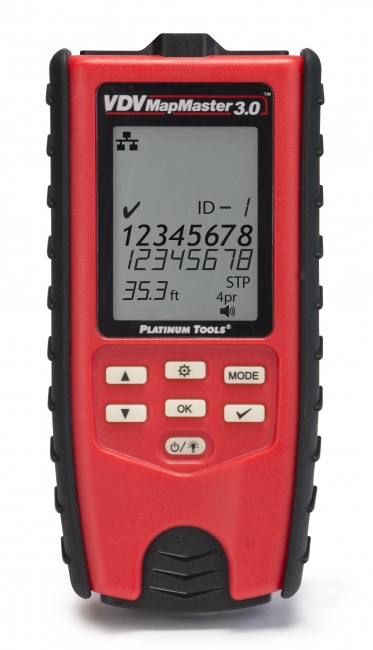
Measuring these parameters is what certification means, and it requires a certifier such as the Fluke DSX2-5000 or DSX2-8000. A qualification tester like the VDV MapMaster 3.0 does not sweep them. It confirms wiremap and length, which is a useful check during the install but not a TIA-568 verdict.
Common Specification Pitfalls
Mismatched components
Every component in the channel must meet or exceed the channel category. A Cat6A cable terminated on Cat6 connectors produces a Cat6 channel, not a Cat6A channel. This is the most common reason a project that "should pass" Cat6A fails certification. Match the connectors to the cable: ezEX48 Cat6A for Cat6A cable, ez-RJ45 Cat6 for Cat6 cable.
Workmanship at the connector
TIA-568 assumes proper termination practices. Excessive pair untwist (more than 13 mm at the connector for Cat5e/Cat6, less for Cat6A), incorrect jacket strip length, and under-crimped contacts all push the link out of spec. See our guide on why your Cat6A crimps keep failing.
Bend radius and tension
TIA-568.1-D specifies minimum bend radii (4x cable diameter unloaded, 8x loaded for unshielded) and maximum pulling tension (110 N or 25 lbf for typical 4-pair cable). Exceeding these damages the pair geometry and degrades NEXT permanently. The damage is invisible from the outside.
Tester configuration
The tester must be set to permanent link or channel mode to match the test configuration. Running a channel test on a permanent link gives a misleading pass because the limits are looser. Running a permanent link test with patch cords attached fails because the cords add length and connector points.
Tools That Keep You Compliant
TIA-568 compliance is enforced at three points: termination, testing, and documentation. Here are the tool categories that matter.
Termination
Pass-through crimp tools and category-specific connectors deliver consistent terminations that meet TIA-568 component specs.
For mixed-category jobs, stock both ezEX44 (Cat5e/Cat6) and ezEX48 (Cat6A) plugs.
Link testing during the install
A qualification tester confirms wiremap and length before certification day.
The MapMaster confirms T568A/B wiremap and length, which is the check you make during the install. It does not produce a TIA-568 certification verdict.
Stripping and prep
Consistent jacket strip length is the foundation of every TIA-568 termination. A category-rated stripper makes the geometry repeatable.
For Cat6A and shielded cable, an adjustable round-cable stripper that scores without nicking the conductors is essential.
Related Reading
Frequently Asked Questions
What is TIA-568?
TIA-568 is the family of structured cabling standards published by the Telecommunications Industry Association. It defines the minimum requirements for commercial telecommunications cabling systems, including cable categories (Cat5e through Cat8), connector specifications, link and channel performance requirements, topologies, and testing procedures. TIA-568 is the document that drives how a low-voltage installer plans, installs, and certifies a structured cabling job in North America.
What is the difference between T568A and T568B?
T568A and T568B are the two pinout standards defined within TIA-568 for terminating an 8P8C connector. They swap the orange and green pairs. T568A is the recommended pinout for new installations under TIA-568.1-D and is used by federal jobs, residential installs (TIA-570), and most modern commercial work. T568B is more common in legacy installations and is functionally equivalent on a straight-through cable. Both ends of a cable must use the same scheme.
What are the cable categories defined in TIA-568?
TIA-568.2-D recognizes Category 5e, Category 6, Category 6A, Category 8.1, and Category 8.2. Cat3 is still referenced for voice-grade applications but is no longer recommended for data. Cat7 is not a TIA category (it is ISO/IEC only). For new installations, Cat6A is the most common specification because it supports 10 Gigabit Ethernet at the full 100-meter distance.
What is the difference between channel and permanent link?
Permanent link is the fixed installed cabling between two telecommunications outlets, including the wall jack, the horizontal cable, and the patch panel termination. Channel is the entire end-to-end connection including the patch cords at each end. TIA-568 defines separate performance limits for each. The permanent link is what the installer is responsible for; the channel is what the network actually uses.
Does TIA-568 require certification testing?
TIA-568 specifies the performance requirements that a link or channel must meet. The standard does not strictly require third-party certification, but it is the only practical way to prove the cabling meets the spec. Most commercial installations include certification reports as a contract deliverable. Certification requires a certifier that measures insertion loss, NEXT, and return loss against the limit lines for the installed category. A VDV MapMaster 3.0 verifies the link during the install but does not produce that verdict.
Ready to Certify to TIA-568?
Compliance starts with consistent terminations and ends with a documented test report. The right crimper, the right connectors, and a category-rated tester are the difference between a pass and a punch list.
Speccing tools for a certification job? Talk to us — we'll match connectors, crimpers, and testers to your cable category.