The Quick Answer
The shielded vs unshielded debate has more myth than substance. Sales literature pushes shielded as "future-proof" or "premium," but in most environments, unshielded UTP is the engineering correct answer. Shielding solves a specific problem (electromagnetic interference) and creates new problems if installed wrong (ground loops, antenna effects, termination failures). This article breaks down where each one belongs.
What Shielding Actually Does
Twisted pair cable rejects electromagnetic interference primarily through the geometry of the twist. Equal and opposite signals on the two conductors cancel out external noise that couples equally into both wires. This is why "twisted pair" works at all, and why the twist rates matter so much.
Shielding adds a metallic barrier (foil, braid, or both) around the conductors. The shield provides additional EMI rejection by reflecting and absorbing electromagnetic energy before it reaches the conductors. When properly grounded, the shield drains induced currents to ground rather than letting them couple into the signal pairs.
The key word is "properly grounded." A shield that is not connected to ground at any point in the link does not provide rejection. A shield grounded at both ends in a building with poor grounding can create ground loops, which produce 60 Hz hum or coupling that can be worse than the EMI it was supposed to block. A shield with breaks (unshielded jacks, ungrounded patch panels) loses the rejection advantage at every break.
Done right, shielding can add 30 to 60 dB of additional rejection at high frequencies. Done wrong, it can subtract from the rejection that the twisted pair geometry was already providing.
Shielding Construction Types
Shielded cable comes in several constructions. The naming convention follows ISO/IEC 11801 format: outer shield / inner pair shield / cable type.
U/UTP (Unshielded)
Standard unshielded twisted pair. No foil, no braid. Relies entirely on twist rates and pair separator (in Cat6A) for EMI rejection. The default for office, residential, and most commercial installations.
F/UTP (Foiled)
Aluminum foil wrap around all four pairs, no individual pair shields. The foil provides moderate EMI rejection and is easier to terminate than fully shielded varieties. Common in Cat6A constructions intended for general 10G use in mixed environments.
U/FTP (Pair-Shielded)
Individual foil shields around each twisted pair, no overall shield. Targets crosstalk between pairs (PSANEXT, alien crosstalk) more than external EMI. Used when bundle density is high and 10GBASE-T performance margin is critical.
S/FTP (Fully Shielded)
Individual foil around each pair plus an overall braided shield. The most thorough construction. Required for some Cat6A specifications, all Cat7, and all Cat8. Heavy, stiff, and difficult to terminate, but provides the highest EMI rejection.
SF/UTP
Foil plus braid as overall shielding, no individual pair shields. A compromise between F/UTP and S/FTP. Uncommon outside specific applications.
Shielded vs Unshielded: Side by Side
Here is how the two compare across the metrics that matter on a job.
| Factor | Unshielded (UTP) | Shielded (STP) |
|---|---|---|
| EMI Rejection | Twist rates only | Twist + 30-60 dB shield |
| Termination Complexity | Standard | Higher (shield path, drain) |
| Cost (cable) | Baseline | 30-60% higher |
| Cost (connectors) | Baseline | 2-3x higher |
| Cable Stiffness | Flexible | Stiff, larger bend radius |
| Grounding Required | No | Yes, single-point ground |
| 10GBASE-T Performance | Sufficient in most environments | Better margin in high-density |
| Failure Mode if Wrong | Predictable degradation | Worse than UTP if grounded poorly |
| Typical Use | Offices, homes, commercial | Industrial, medical, data center |
For most installations, unshielded UTP is the engineering correct choice. Shielded becomes correct only when you can name the specific EMI source you are defeating.
When Shielded Is the Right Choice
Industrial floors with VFDs and motors
Variable frequency drives (VFDs), large AC motors, welding equipment, and induction heaters generate broadband electromagnetic noise that can couple into nearby cable. On a manufacturing floor where Ethernet runs near these sources, S/FTP cable with shielded connectors gives you the rejection margin to keep links stable.
Hospital imaging and medical environments
MRI suites, X-ray rooms, and CT scanner areas have their own EMI environments and grounding requirements. Hospital IT specs almost always require shielded cabling in clinical areas, both for EMI rejection and for compliance with medical electrical safety standards.
Parallel runs near power conductors
NEC and BICSI both specify minimum separation distances between data cable and power conductors. When you cannot meet those distances (a short parallel run forced by building constraints), shielded cable provides protection that lets you maintain the run within performance specs.
10GBASE-T in high-density bundles
10GBASE-T is sensitive to alien crosstalk (NEXT between adjacent cables in a bundle). Unshielded Cat6A handles this in normal bundle densities, but pair-shielded U/FTP or fully shielded F/UTP gives you margin when 24-cable bundles run in tight cable trays. For more on the 10G distance question, see Cat6 vs Cat6A.
Outdoor and direct-buried runs
Outside plant cabling has different EMI exposure than inside plant. Lightning-induced surges, RF energy, and varying ground potential all argue for shielded constructions in OSP applications. The shield also typically includes a metallic vapor barrier that helps with moisture protection.
Government and security sensitive environments
SCIFs (Sensitive Compartmented Information Facilities) and other secure environments require shielded cabling to limit electromagnetic emanations from data lines. This is a regulatory requirement, not just a performance one.
When Unshielded Is the Right Choice
Office buildings
Standard office environments do not have EMI sources strong enough to require shielded cable. Fluorescent lights, desktop equipment, and HVAC systems all produce noise that is well within what UTP twist rejection handles. Cat6 or Cat6A UTP is the default specification for nearly all commercial office cabling.
Residential
Home networking environments are quiet from an EMI perspective. There is no engineering case for shielded cable in a residence except in very specific situations like running cable parallel to high-current home runs in a panel area. Use UTP unless you have a documented reason not to.
Standard commercial installations
Retail, hospitality, education, light commercial. All of these are UTP territory. The cost premium for shielded provides no measurable benefit in these environments and adds termination complexity that increases the failure rate.
When you cannot guarantee grounding quality
If the building has questionable grounding, multiple ground potentials, or no clear single-point grounding plan, shielded cable will be a liability rather than an asset. Bad grounding turns the shield into an antenna or a ground loop. UTP avoids the issue entirely.
The Grounding Problem
Shielded cable only works if the shield is grounded. The accepted practice is single-point grounding, typically at the patch panel or telecom room side of the link, never the user side. Both ends grounded creates ground loops in buildings with multiple ground potentials, which can inject 60 Hz hum into the data signal.
For shield grounding to work:
- The patch panel must be bonded to building ground. Through the rack, cabinet, or a dedicated ground bar.
- The connectors must maintain shield continuity. Every shielded RJ45 plug, jack, and patch panel port must have a metallic path from the cable shield to the rack ground.
- The user end stays floating. The shield does not connect to ground at the device end, only at the telecom room end. The cable acts like a one-sided drain to ground.
- No mixed shielded and unshielded components. An unshielded jack in a shielded link breaks the shield continuity at that point.
This single-point grounding requirement is one of the reasons why shielded cabling has higher installation complexity than UTP. Every component in the link has to participate in the shield path correctly, or the whole shielding strategy fails.
How to Terminate Shielded RJ45
Terminating shielded cable is a different process than terminating UTP. The shield must be properly trimmed, dressed, and connected to the connector's metallic shield housing.
- Strip the jacket cleanly. Use the Cat5/6 Jacket Stripper to avoid nicking the shield.
- Identify the shield construction. Note whether you have foil, braid, or both, and whether each pair has its own foil.
- Fold the foil or braid back over the jacket. Roughly 0.5 inch of shield should be exposed and folded back so the connector strain relief makes contact with it.
- Trim the drain wire if present. The drain wire is the bare conductor running alongside the shield. Trim it to match the conductor length so it lands in the connector's drain wire port (if the connector has one).
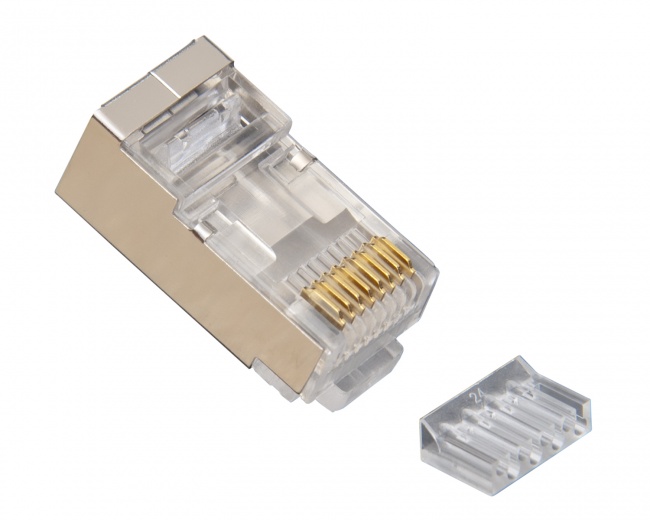
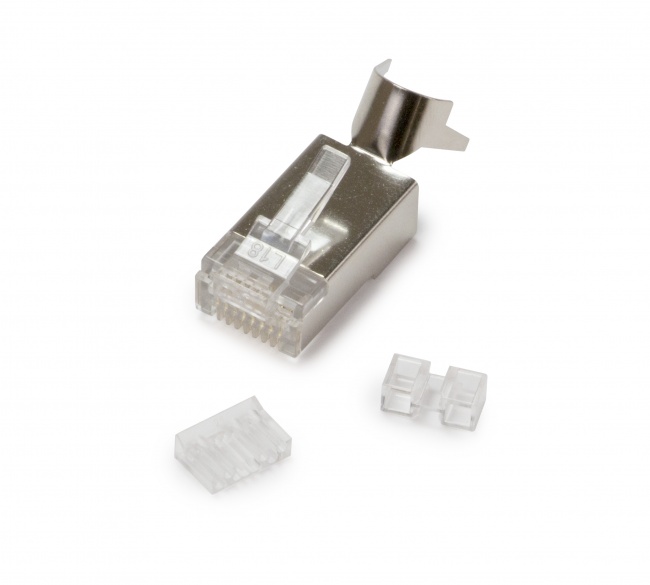
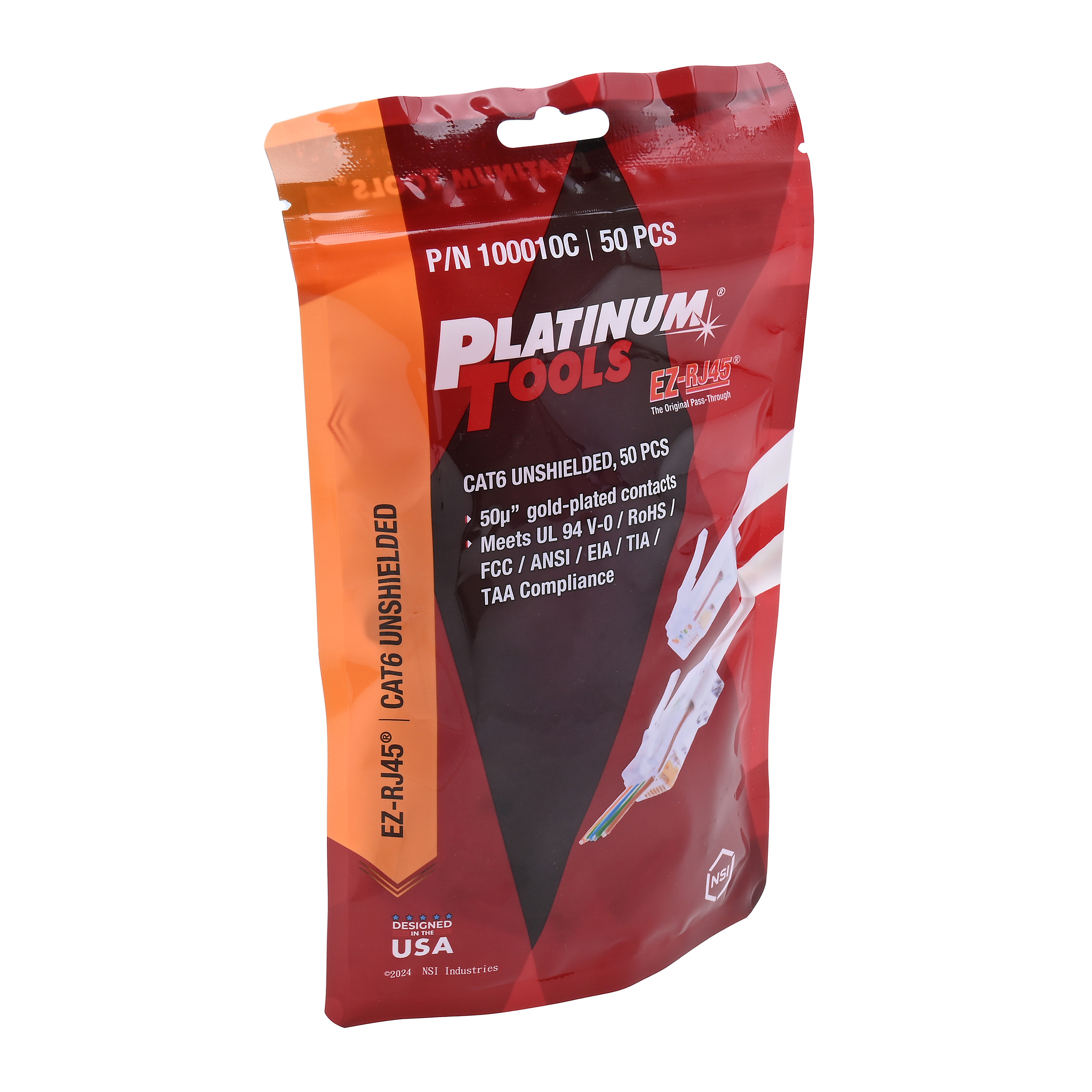
- Insert the cable into a shielded RJ45. The Cat6A/7 Shielded or Shielded EZ-RJ45 Cat6 connectors have metallic housings that contact the cable shield.
- Crimp with the appropriate tool. The PTS PRO Universal Crimp Tool handles all shielded and unshielded variants.
- Test for shield continuity. A tester that supports shielded cable checks shield continuity along with wire map. The VDV MapMaster 3.0 reports STP when the shield is continuous end to end and UTP when it is not, with the remote plugged in at the far end.
The Cost Math
Shielded cable and connectors cost more than UTP. The premium varies but is significant when summed across a job:
- Cable: F/UTP and S/FTP run 30-60% more per foot than U/UTP at the same category.
- Connectors: Shielded RJ45 connectors are typically 2-3x the price of unshielded equivalents.
- Patch panels and jacks: Shielded keystones and shielded patch panels add another 50-100% to the basic equipment cost.
- Labor: Shielded terminations take roughly 50% longer per termination once you account for shield trimming and drain wire dressing.
- Grounding hardware: Bonding straps, ground bars, and supplemental grounding can add real money on a large job.
On a 200-drop office build, the difference between U/UTP Cat6A and F/UTP Cat6A can easily run $5,000-$10,000 in materials and labor. If there is no engineering reason to spec shielded, that money is wasted.
Decision Framework
Before specifying shielded cable on a job, answer these questions:
- What specific EMI source are we defeating? If you cannot name it, you do not need shielding.
- Will the building support proper single-point grounding? If the answer is no or unknown, shielded cable will perform worse than UTP.
- Will every connector, jack, and patch panel be shielded? Mixed components break the shield path.
- Is the bend radius and pulling tension increase acceptable? Shielded cable is stiffer and harder to pull through tight conduits.
- Is the cost premium justified? Calculate the materials and labor difference against the EMI risk.
If you cannot answer all five with a clear yes, default to UTP. UTP that is properly installed will outperform poorly installed shielded cable every time.
Related Reading
- Shielded vs Unshielded Connectors: When Shielding Matters Companion piece focused on the connector side specifically.
- Cat6 vs Cat6A: What's the Difference? Background on category selection.
- Cat5e vs Cat6 vs Cat6A: Complete Comparison Performance differences across categories.
- BICSI Cable Installation Standards Includes grounding and bonding requirements.
Recommended Products
Shielded RJ45 Connectors
Connectors with metallic shield housing for STP and FTP cable
Match the connector category to your cable. Cat6A/7 Shielded handles 10G shielded runs. Cat5/Cat6 shielded for legacy and Cat6 STP.
Compatible Crimp Tools
Tools that handle the slightly larger shielded connector bodies
PTS PRO is the most versatile choice for shielded work. EzEX Crimp Tool also handles shielded ezEX variants.
Shield Continuity Testing
Verify the shield path along with wire map
The MapMaster checks basic shield continuity: STP when the shield is continuous at both ends, UTP when it is not. Run it with the remote at the far end, since a single-ended test does not check the shield at all.
Frequently Asked Questions
When do I need shielded RJ45 connectors?
Shielded RJ45 connectors are needed when the cable runs through high-EMI environments such as industrial floors, near large motors or VFDs, parallel to power conductors over short distances, or in hospital imaging suites. They are also required for 10GBASE-T at the full 100-meter distance in some Cat6A specifications. For typical office, residential, and commercial cabling, unshielded UTP is sufficient.
Does shielded cable require shielded connectors?
Yes. Shielded cable must be terminated with shielded connectors to maintain shield continuity. Using unshielded RJ45 connectors on shielded cable defeats the purpose. The shield needs a continuous path from the cable foil or braid through the connector and into the grounded jack or patch panel. Use the Cat6A/7 Shielded for STP terminations.
Can shielded cable make EMI worse?
Yes. Improperly grounded shielded cable can act as an antenna and pick up more EMI than unshielded cable would. The shield must be terminated and grounded at one end, typically the patch panel side. Floating shields, double-grounded shields creating ground loops, or broken shields all degrade performance below what UTP would provide.
Is unshielded Cat6A enough for 10 Gigabit Ethernet?
Usually yes. Unshielded Cat6A (U/UTP with internal pair separator) supports 10GBASE-T at the full 100-meter distance in environments with normal ambient noise. In high-density bundles or noisy environments, F/UTP or U/FTP shielded Cat6A provides better margin against alien crosstalk.
What is the difference between F/UTP, S/FTP, and U/FTP?
F/UTP has overall foil shielding around all four pairs but no individual pair shields. S/FTP has individual foil around each pair plus an overall braided shield. U/FTP has individual foil around each pair but no overall shield. Each construction targets a different EMI scenario, with S/FTP providing the most protection at the cost of stiffness and termination complexity.
Get the Right Connectors for the Job
Match the connector to the cable. Unshielded for standard installations, shielded for industrial and medical environments. The right pairing keeps your terminations within spec.