The Quick Answer
The PoE standards (802.3af for original PoE at 15.4W, 802.3at for PoE+ at 30W, and 802.3bt for PoE++ at 60W or 90W) all assume the cable plant is properly installed. The math behind voltage drop and heat assumes a healthy crimp with low contact resistance. A marginal termination changes those numbers and can cause real damage at higher power levels.
Why PoE Termination Matters
Resistance becomes heat
Every termination point has some resistance, even a perfect one. The contact between the conductor and the IDC blade or the contact pin is not a zero-ohm path. A typical good RJ45 termination has about 2-5 milliohms of contact resistance. A marginal one might have 50-100 milliohms.
At low data signaling currents this resistance is irrelevant. At PoE+ supplying 600 mA per pair and PoE++ supplying 960 mA per pair, the same resistance dissipates real power as heat. A 50 milliohm termination at 960 mA dissipates 46 milliwatts at the contact, which is enough to noticeably warm the connector.
Voltage drop limits the device
The PoE standards specify the voltage delivered at the powered device (PD), not at the power source equipment (PSE). On a long cable run, voltage drops along the conductors and across each termination. If the drop is too large, the PD does not receive enough voltage to operate, even if the math says the PSE was supplying enough power.
The standards account for typical cable losses but assume good terminations. Bad terminations effectively shorten your maximum cable length.
Failure modes
- Connector overheating: The plastic body of the connector warms above 70-80°C, deforming the contact alignment and degrading further. In extreme cases the connector melts.
- Cable jacket damage: The first 6 inches of cable behind the connector heat up where the conductors carry the highest current. PVC insulation can soften.
- Intermittent power: Marginal contacts pass the link negotiation but drop under load. The PD reboots, link comes back, then reboots again.
- Reduced device performance: A camera or AP that runs at PoE+ may run slower or with reduced PoE budget if voltage at the PD drops below spec.
Cable Selection for PoE
| PoE Type | Power | Recommended Cable | Max Length |
|---|---|---|---|
| PoE (802.3af) | 15.4W | Cat5e 24 AWG or better | 100m |
| PoE+ (802.3at) | 30W | Cat5e/Cat6 23 AWG | 100m |
| PoE++ Type 3 (802.3bt) | 60W | Cat6 or Cat6A 23 AWG | 100m |
| PoE++ Type 4 (802.3bt) | 90W | Cat6A 23 AWG (recommended) or 22 AWG | 100m |
The recommendations above are conservative. The IEEE standards permit lower-grade cable in many cases, but field experience consistently shows that PoE installations are more reliable on better cable. The cost difference between Cat5e and Cat6A on a single run is small; the cost of a service call to fix an overheating PoE camera is large.
For more on cable requirements, see our PoE cable requirements guide.
Conductor Material: Pure Copper Only
Skip CCA (copper-clad aluminum) cable for PoE. CCA has thinner copper plating over an aluminum core. The aluminum core has roughly twice the resistance of pure copper of the same gauge, which doubles the heat generation under PoE load.
CCA cable is also more susceptible to fatigue cracking at termination points because aluminum work-hardens under repeated bending. A CCA cable that passed initial testing can develop intermittent breaks at the connector after months of normal cable movement.
Always verify your cable is solid pure copper. Look for "BC" (bare copper) or "Solid Copper" on the jacket print. If it says "CCA," return it.
Termination Step by Step
Step 1: Match connector to cable category
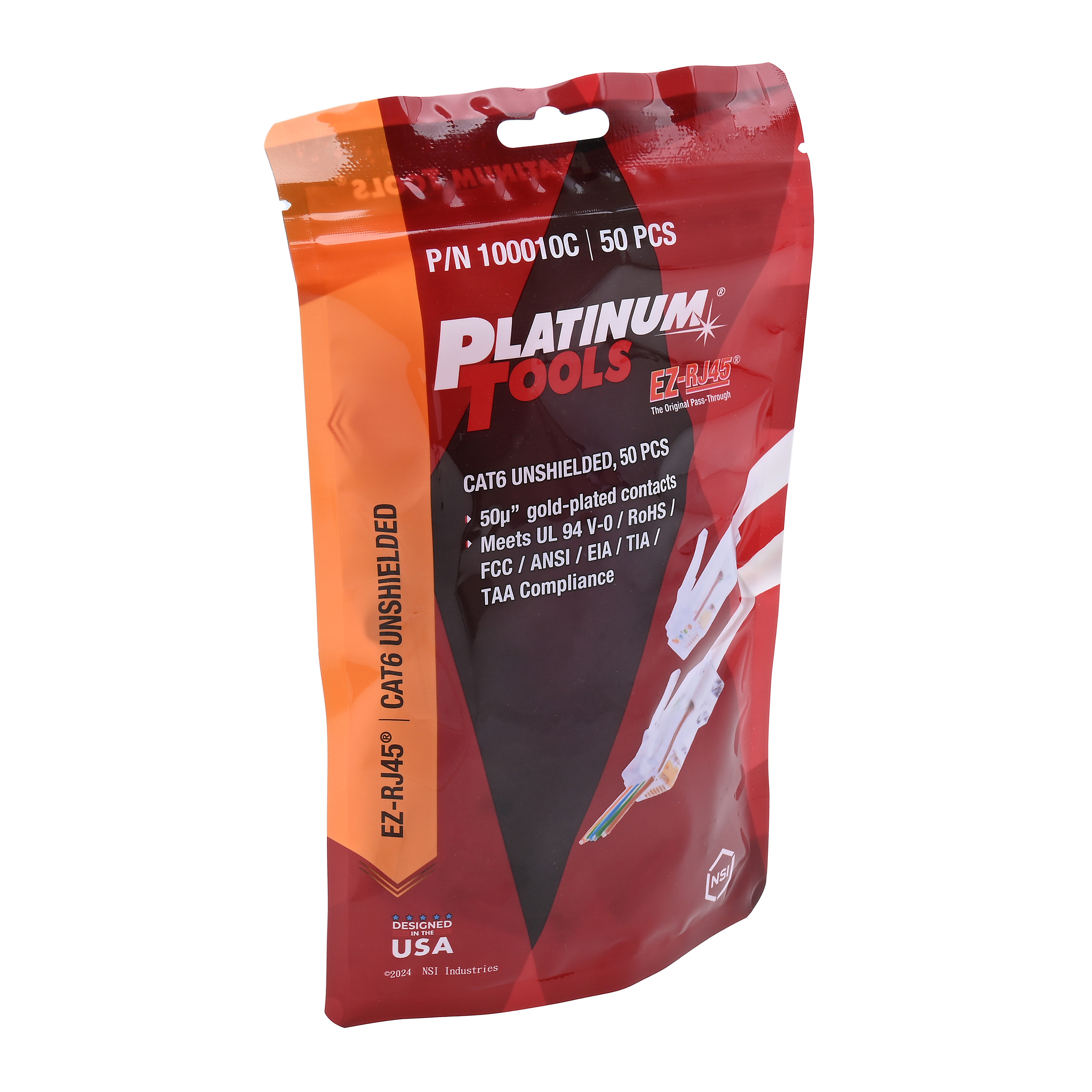
For PoE-grade Cat6, use EZ-RJ45 Cat6 or ezEX44 Cat6 connectors. For Cat6A, use ezEX48 Cat6A. The pass-through design of these connectors lets you visually verify that all 8 conductors are seated before crimping, which eliminates the partial-contact failures that cause heat problems on PoE.
Step 2: Strip the correct length
Strip 1.25 to 1.5 inches of jacket depending on cable type. Use a stripper with adjustable depth so you do not nick the conductors. A nicked conductor under PoE load develops a hot spot at the nick.
Step 3: Trim the separator
For Cat6 and Cat6A, trim the central separator flush with the jacket. Leaving a long separator inside the connector body can prevent the conductors from seating fully against the contact blades, which increases contact resistance and heat.
Step 4: Untwist minimally
Untwist each pair just enough to lay them flat. The 568 specification calls for a maximum 0.5 inch untwist. For PoE, less is better. Untwisting changes the impedance of the pair and increases AC losses. While AC losses do not directly cause DC heating, excessive untwist correlates with general termination quality.
Step 5: Verify pass-through alignment
For pass-through connectors, push the wires until they emerge from the front of the connector. Verify all 8 conductors are present, in the correct color order, and emerge fully. A wire that did not pass all the way through the connector has not reached the contact blade and will be a high-resistance contact under PoE load.
Step 6: Crimp with the correct tool
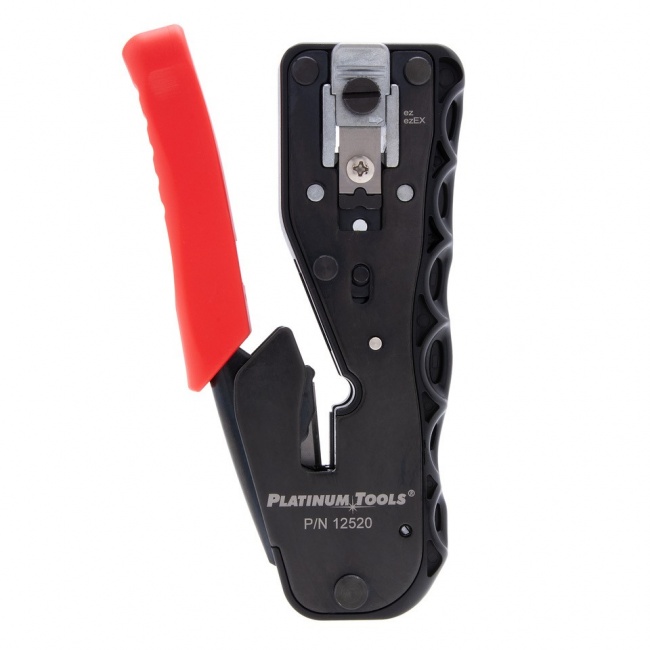
Use the PTS PRO Universal Crimp Tool or the EzEX Crimp Tool. Complete the full ratchet cycle. A partial crimp leaves the contact blades in a marginal position. On a data-only cable that might still pass; on a PoE cable it produces heat.
Bundling and Heat Management
PoE current produces heat along the entire cable, not just at the connectors. In a bundle of 24 active PoE++ cables in a tray, the cumulative heat can be substantial.
Bundle size limits
- PoE (15.4W): No special bundling concerns; standard 24-cable bundles are fine.
- PoE+ (30W): Limit bundles to 24 cables in still air. Larger bundles need spacing or ventilation.
- PoE++ Type 3 (60W): Limit bundles to 12-16 cables, or use cable with explicit PoE bundle ratings.
- PoE++ Type 4 (90W): Limit bundles to 6-12 cables in active power mode, or specify cable rated for high-density PoE bundles.
Some Cat6A cable is specifically rated for PoE bundling and lists a maximum bundle size on the data sheet. Use that rating, not a generic limit. For the underlying standards, see our BICSI cable installation standards overview.
Testing PoE Terminations
Standard wire map testing catches opens and shorts but does not measure contact resistance or PoE delivery. For PoE installations, use a tester that explicitly reports PoE voltage and class.
What to test
- Wire map: All 8 pins continuous, no opens or shorts.
- Length: Within 100m. Longer runs need higher-voltage PoE specs.
- PoE class detection: The tester sees the PSE class advertisement.
- PoE voltage at PD end: Measured voltage at the device side.
- PoE current under load: Some testers can simulate a load to verify the PSE actually delivers power.
The first two of those are wire map and length, and the VDV MapMaster 3.0 covers both. The Digital Tone & Probe Kit emulates a powered device and lights one LED per pair, so you can see which pairs are actually delivering power. A measured voltage and class readout is a different instrument and not one we sell. For what those readings mean and how to tell a switch problem from a cable problem, see our PoE tester guide.
PoE Power Budget Math
Understanding how PoE budget works helps you predict whether a particular run will succeed before you install it.
Available power at the device
PSE delivers a specific voltage and current. By the time the power reaches the device, it has dropped some amount due to the resistance of the conductors and the contacts. The remaining power is what the device sees.
Worst-case calculation
For a 100-meter Cat6 run carrying 30W PoE+:
- Cable resistance: about 9 ohms round-trip on a single pair
- Voltage drop at 600 mA: 9 ohms x 0.6 A = 5.4 V
- If PSE delivers 50V, the PD sees 44.6V (within 802.3at spec of 42.5V minimum)
Add a marginal connector with 50 milliohms additional resistance per termination, and you add another 60 mV of drop. That is small in isolation. Multiply across an entire installation and across PoE++ at higher current and the marginal terminations start to matter. The IEEE specs include some margin, but a series of small problems adds up.
Voltage classes
- Type 1 (PoE): 44 to 57V at PSE, 36 to 57V at PD
- Type 2 (PoE+): 50 to 57V at PSE, 42.5 to 57V at PD
- Type 3 (PoE++): 50 to 57V at PSE, 42.5 to 57V at PD
- Type 4 (high-power PoE++): 52 to 57V at PSE, 41.1 to 57V at PD
Higher PSE voltage on Type 4 compensates for the larger expected drop on a 90W run. The PD specs are still demanding because the device needs enough voltage to operate.
Field Diagnosis: Hot Connector or Cable
If you find a connector or section of cable that runs noticeably hot under PoE load (warm to the touch is normal at 60W+; hot is not), here is the diagnostic process.
1. Verify the load
Confirm the PSE is actually supplying the power level you expect. A misconfigured switch port might be supplying 90W instead of 30W to a device that can handle either.
2. Inspect the connector
Look for visible discoloration, deformation, or melted plastic. If the connector body is darkening near the contacts, replace it immediately and check the cable behind it.
3. Inspect the cable
Run your hand along the cable for 6-12 inches behind the connector. If a section feels warmer than the rest of the cable, it indicates higher current or higher resistance in that section. Cut back to clean cable and re-terminate.
4. Replace and re-test
Replace the connector with a fresh one. Test PoE voltage at the PD end. If voltage drop is now within spec and the temperature is normal, the original termination was the problem. If the heat returns, the cable itself may be the problem (CCA, damaged, or undersized) and needs replacement.
Recommended Products for PoE Termination
PoE-Ready Connectors
Pass-through connectors that show full conductor seating
For PoE++ at 60W or 90W, ezEX48 Cat6A is the recommended choice. ezEX44 covers Cat6 PoE+ work.
Crimp Tools
Tools that complete a full ratchet cycle for low-resistance crimps
A full ratchet cycle ensures low contact resistance, which keeps PoE current from generating heat at the connector.
PoE Verification
See which pairs are carrying power at the device end
The Digital Tone & Probe Kit emulates a powered device and lights one LED per pair, so you can see which pairs are actually delivering power. A measured voltage and class readout is a different instrument and not one we sell.
Related Articles
Frequently Asked Questions
Does PoE require special cable?
PoE works on standard Cat5e or higher Ethernet cable. The IEEE PoE standards (802.3af, 802.3at, 802.3bt) are designed to work over the existing twisted pair infrastructure. However, for PoE++ at 60W or 90W, larger conductor cable (23 AWG or thicker) and Cat6/Cat6A is recommended to keep voltage drop and heat within spec.
Why does PoE require better terminations than data-only cable?
PoE pushes current through the conductors. Any resistance at a termination converts electrical energy to heat. A marginal crimp on a data-only cable just produces signal errors. The same crimp on a PoE cable produces heat. At 60W or 90W PoE++, a bad crimp can melt the connector or the cable jacket near the termination.
What conductor gauge is required for PoE?
23 AWG is recommended for any PoE installation, especially for runs over 50 meters or for PoE+ and PoE++. 24 AWG works for shorter runs at lower power levels but introduces more voltage drop and runs hotter. The IEEE 802.3bt standard for 90W PoE assumes typical Cat6A 23 AWG cable.
How much heat does PoE generate in the cable?
A 90W PoE++ run on Cat6A 23 AWG cable adds about 8-10 degrees Celsius of temperature rise on the cable jacket. In a tightly bundled cable tray with many active PoE runs, the cumulative heating can push individual cables 15-20 degrees above ambient. This is why PoE-rated cable bundles, ventilation, and the right conductor gauge matter.
Should I use shielded cable for PoE?
Shielded cable helps with EMI but does not directly affect PoE. The bigger PoE-related concern is conductor gauge and termination quality. That said, shielded cable often has thicker conductors and better mechanical properties, so it is a good choice for high-power PoE runs near electrical equipment.
Build PoE-Ready Terminations Every Time
The right connectors and tools turn marginal PoE crimps into reliable ones. A full ratchet cycle on a matched die is what keeps PoE current from heating the contact, and that is the part you control at the crimp.